Wondering what the best waterhole in Etosha for wildlife viewing is?
Do you long to see a leopard? Are hungry for a hyena (there are no hippos in Etosha FYI)? Or would a white rhino send you wild?
Here’s a countdown of our favourite sites across Etosha*
Spoiler: Shortcut to #1


#10 – Kilppan
In the far west of the park, roughly a 15 minute drive west from Dolomite Camp. We visited shortly after sunrise after leaving the camp and managed to spot Hartmann’s Mountain Zebra as well as many Plains zebra and other general game.
The evening before we had visited just prior to sunset and seen a springbok with a broken leg. A jackal was trying to bite at the leg but we seemed to inadvertently scare it away. Vultures were already congregating in the nearby trees, however when we returned in the morning there was no sign of the springbok, nor any vultures remaining.
The western end of Etosha is the quietest area of the park, both in terms of visitors, and general game. The only place to stay here inside the park is Dolomite camp, and there are consequently very few other vehicles on the roads.
Klippan itself had lots of available water and was a wide open space with good viewing from the car park.

#9 – Okondeka
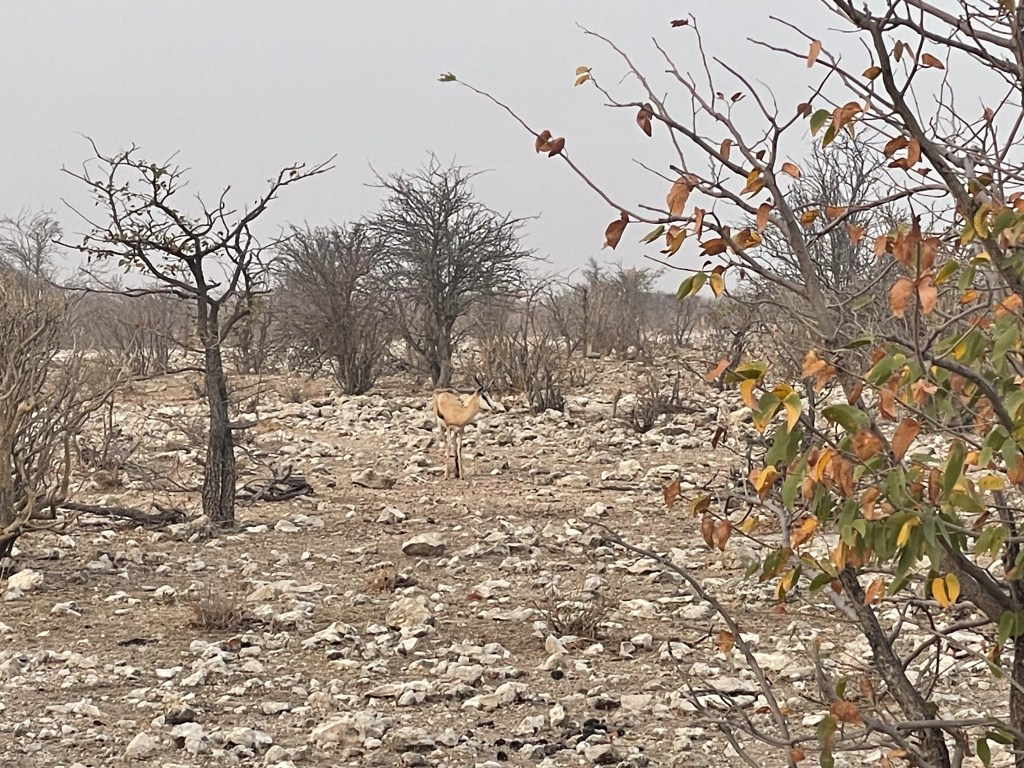
On the western edge of the salt pan is Okondeka, it’s only 20 minutes north of Okaukuejo, but the lack of vegetation on the drive there makes it feel very open and remote.
Okondeka is famous for its lions. Nearby there are plenty of small trees with good shade underneath which would make excellent spots for lions to sleep out of the hot midday sun.
Alas when we were there game was sparse, a few Bateleur eagles soaring around was all it could muster for us, so for that reason it slides down our list to #9

#8 – Aus
Aus is a the very end of a long loop to the east of Okaukuejo. It’s a pleasant drive and a visit is easily combined with Olifantsbad and Gemsbokvlakte
All three of these waterholes had good numbers of general game whilst we were there. Gemsbokvlakte is an open pan, with a good number of ostrich and giraffe present when we visited. Olifantsbad had a tempting looking deep pool of fresh water, zebras lined up photogenically for us when we were there.
However of the three, Aus had the most action, with two very large breeding herds of elephants competing for the freshest water at the fountain.
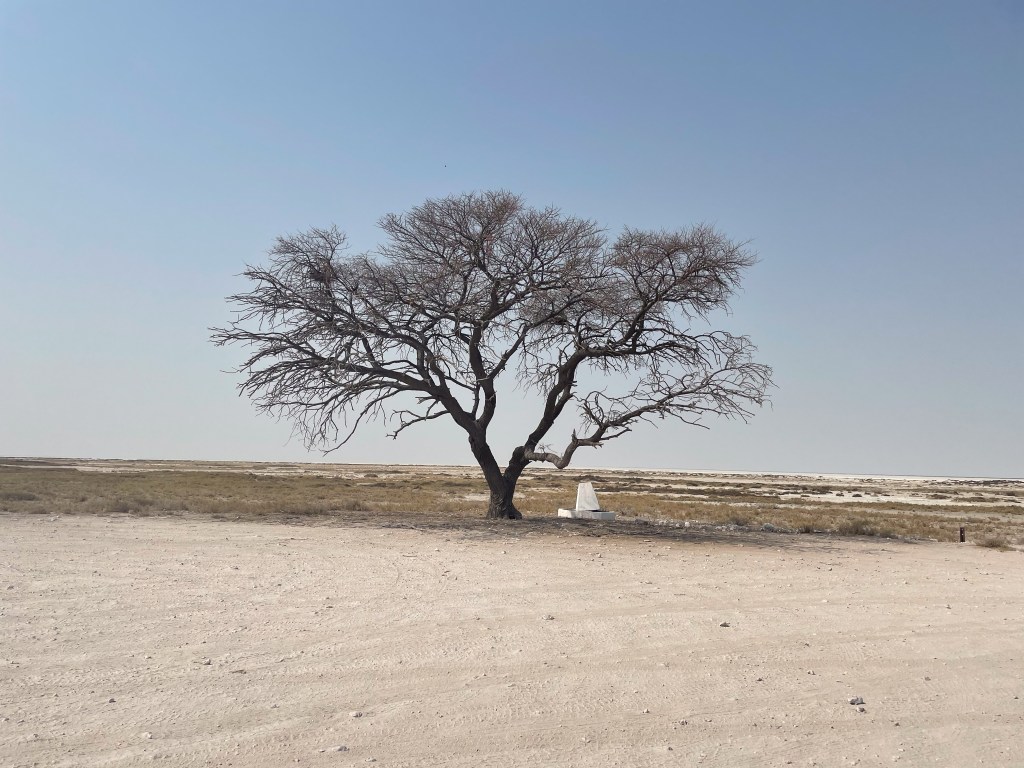
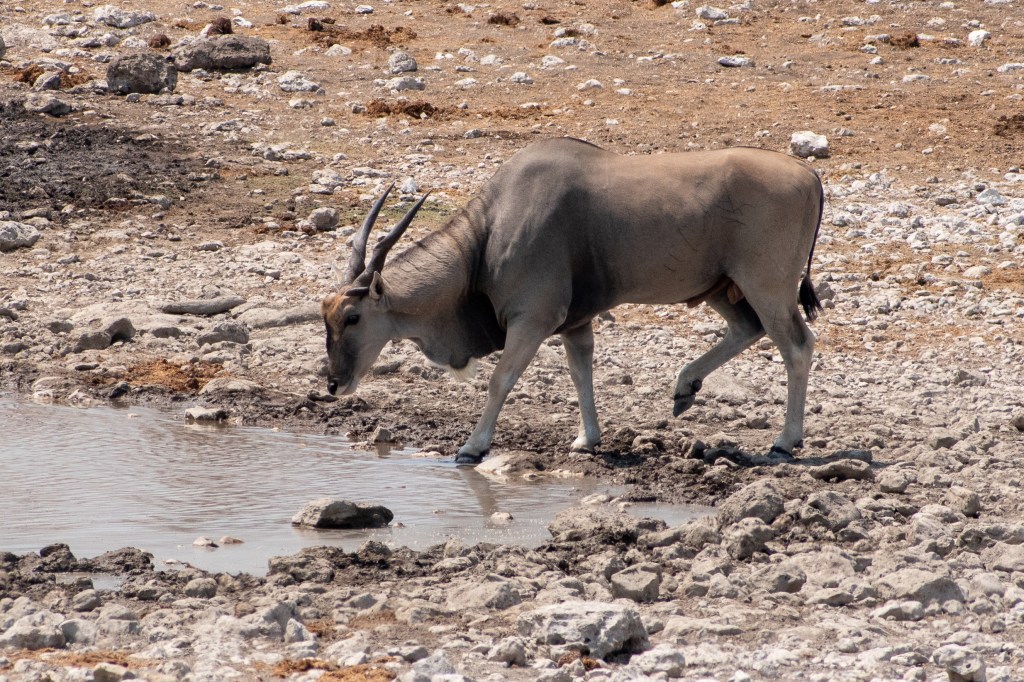
Water from the fountain pooled in the middle of a small valley, the car park was slightly elevated so there was good viewing up and down the valley. We saw an Eland come to drink, as well as jackals playing and a small number of impala. Springbok tend to be the predominant medium sized antelope in the park, so impala were more of a rarity. Etosha is home to the black-faced subspecies, which is a novel adaptation, and something different.
#7 – Olifantsrus
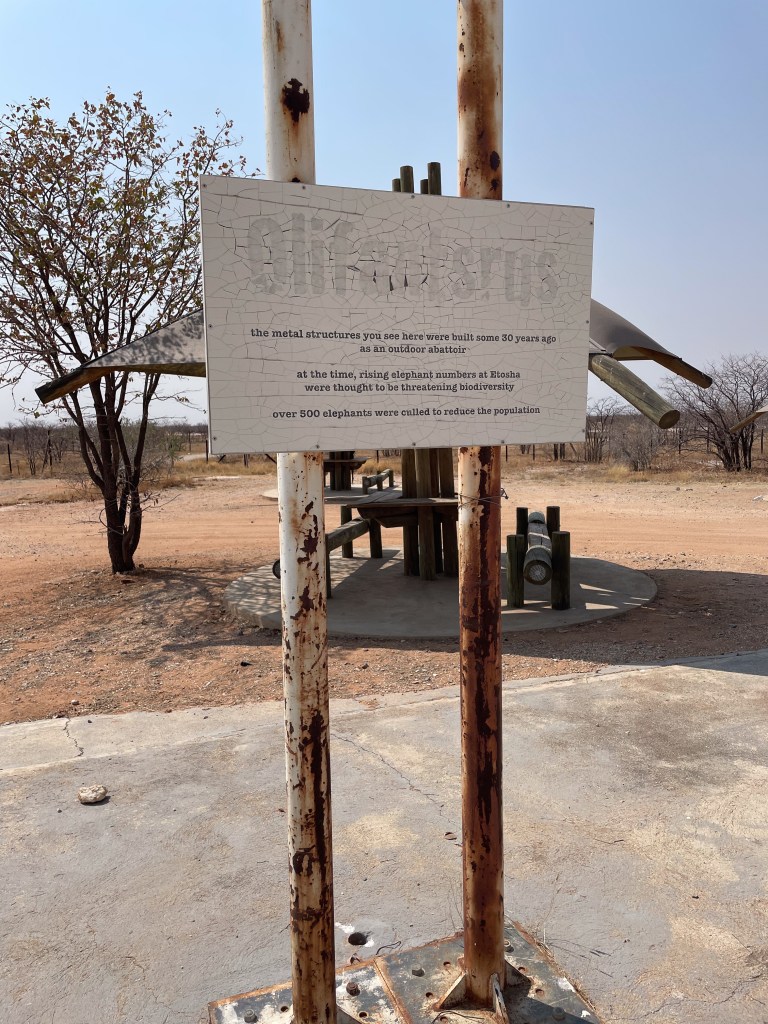
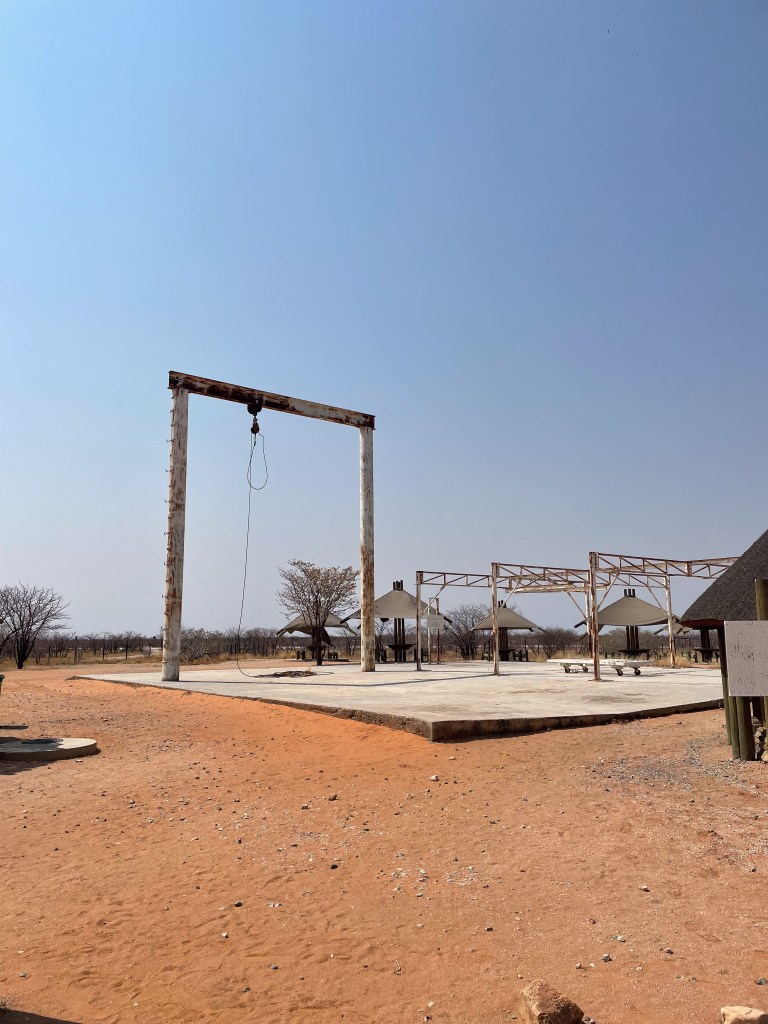
Whilst game viewing for us was limited here, Olifantsrus makes it onto our list by virtue of having an epic hide. Two stories tall, and reached by a long snaking footbridge from the fenced camp, I’m sure there are plenty of opportunities for great game viewing here. Especially if you were to camp at the adjoining campsite.
In the Olifantsrus camp there is a small shop and a museum, as well as a preserved elephants gallows from the days when they were culled in the region.
Thankfully now the population of elephants in Etosha is very healthy and they’re a common sight all over the park.


#6 – Tobiroen
There was a big party going on at Tobiroen when we stopped by on our long drive from Dolomite to Halali. It’s important to remember that it’s 175km from Dolomite to Okaukeujo and it will take many hours to travel across the park, especially on the variable quality gravel roads, and sticking to the 60km/h speed limit.
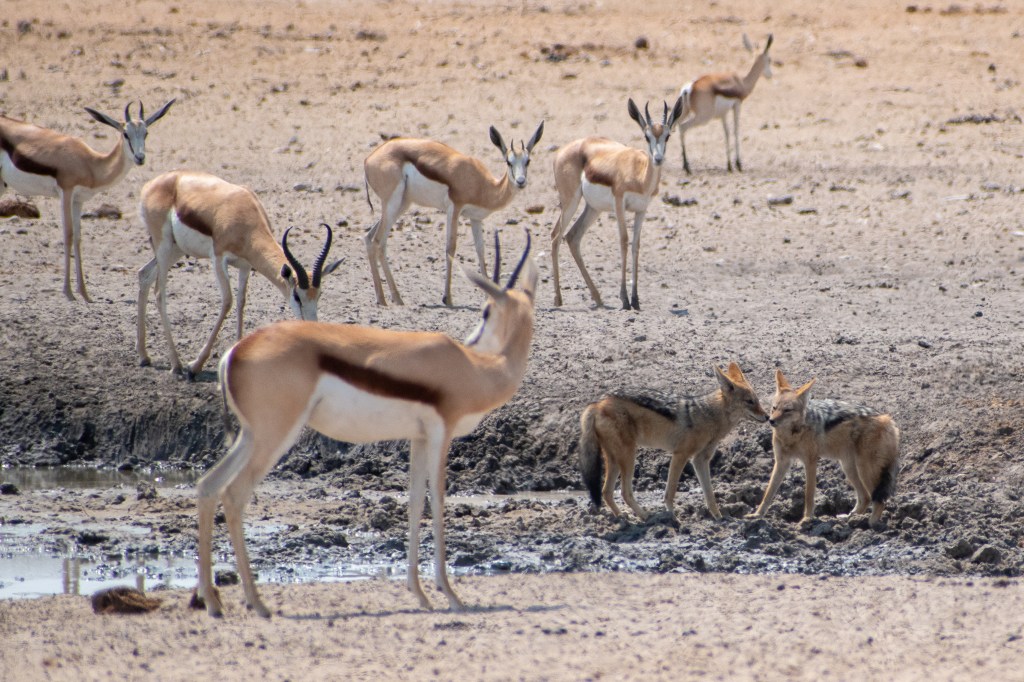
An elephant was bathing in the mud in front of us, and he was joined by a pair of jackals who were grooming each other down by the water. Large numbers of Zebra, wildebeest, and springbok were dotted around the scene. A tawny eagle was sat in the mud for some reason, and a Hammerkop was also chilling nearby. Up in the sky we spotted a black chested snake eagle. All in all there was plenty for everyone at this midday stopover.


#5 – Rietfontein
On the two separate occasions we stopped at Rietfontein we were greeted by a solitary Black Rhino drinking by the water’s edge.
Both times it was a different rhino. The first was in the evening. 20 minutes before sunset, and a 20 minute drive from Halali camp, he almost made us miss the gate closing time.
The following morning we returned to Rietfontein after spending time at Goas. Another rhino was there, in almost exactly the same place. He was very very wary of approaching the water. An elephant was bathing in the middle of the reeds in the centre of the waterhole, which may have given the rhino pause for thought. However this guy would be frightened of anything, quick to perceive danger, but pathetic at identifying it. We watched him finally reach the water to drink, and then left him in peace.

#4 – Salvadora
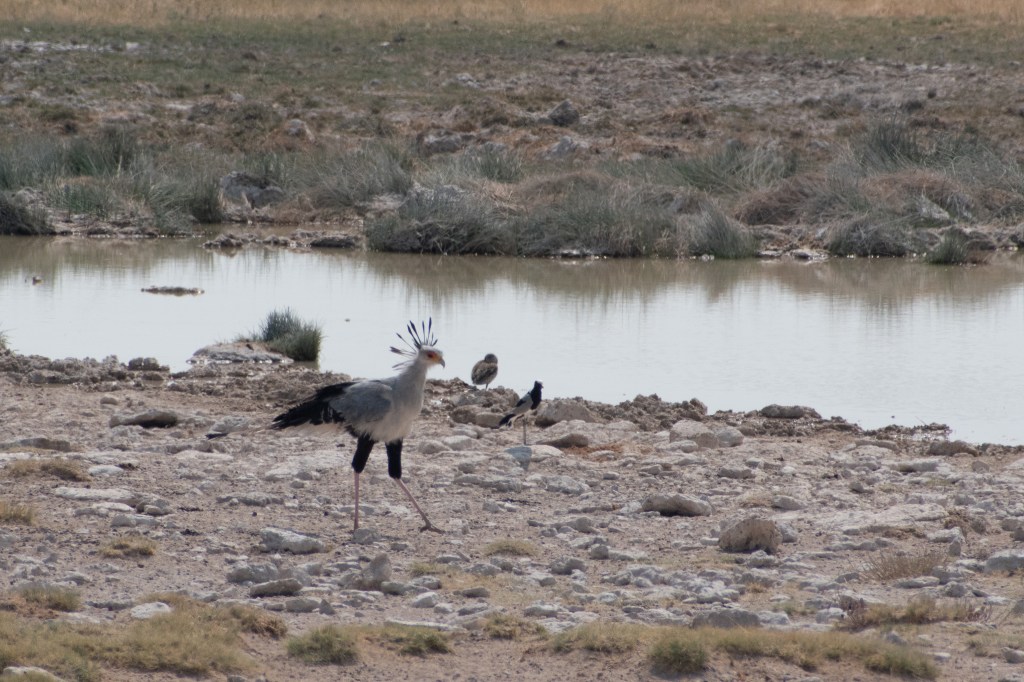
Overlooking the Etosha pan, Salvadora is a stunning location. The car park is elevated up above the surrounding grassland enabling the perfect view. There’s the odd tree dotted around, but visibility is excellent.
In terms of wildlife all we saw here was a secretary bird being hassled by plovers. We stopped by this location no less than three times in a day as it seemed so promising, however all it gave us were great views.
Commonly touted as the place to visit to spot cheetah, we saw none, however the landscape around the waterhole is very much cheetah country.
A good spot for breakfast with a view, we spent some time sitting and just looking out over the expanse. This behaviour attracted plenty of others to the car park to see what we had in our sights. We playfully gazed towards the horizon through our binoculars, but we had nothing, and eventually the five or six cars who had joined us left for pastures new.

#3 – Koinachas
Our bias for great sightings really shines though – what we’d read about Koinachas was that it was pretty, but rarely productive of good sightings.
Barely a 5 minute drive from Namutoni camp, it was our last stop in the evening before sunset, and our first stop in the morning to try our luck.
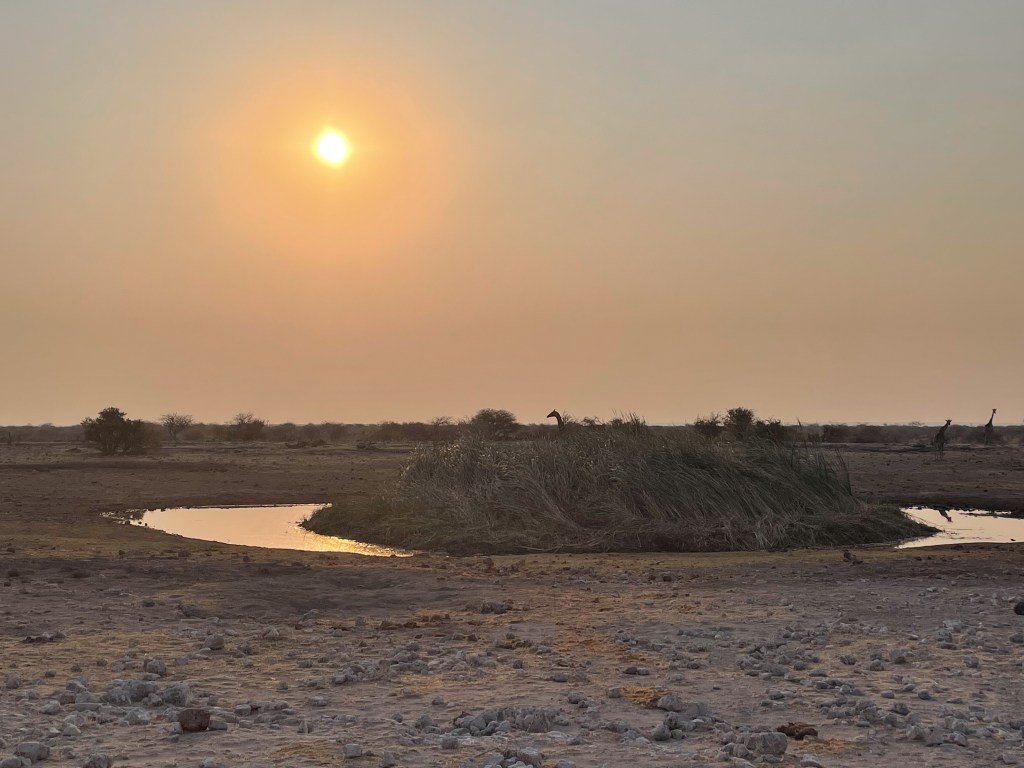
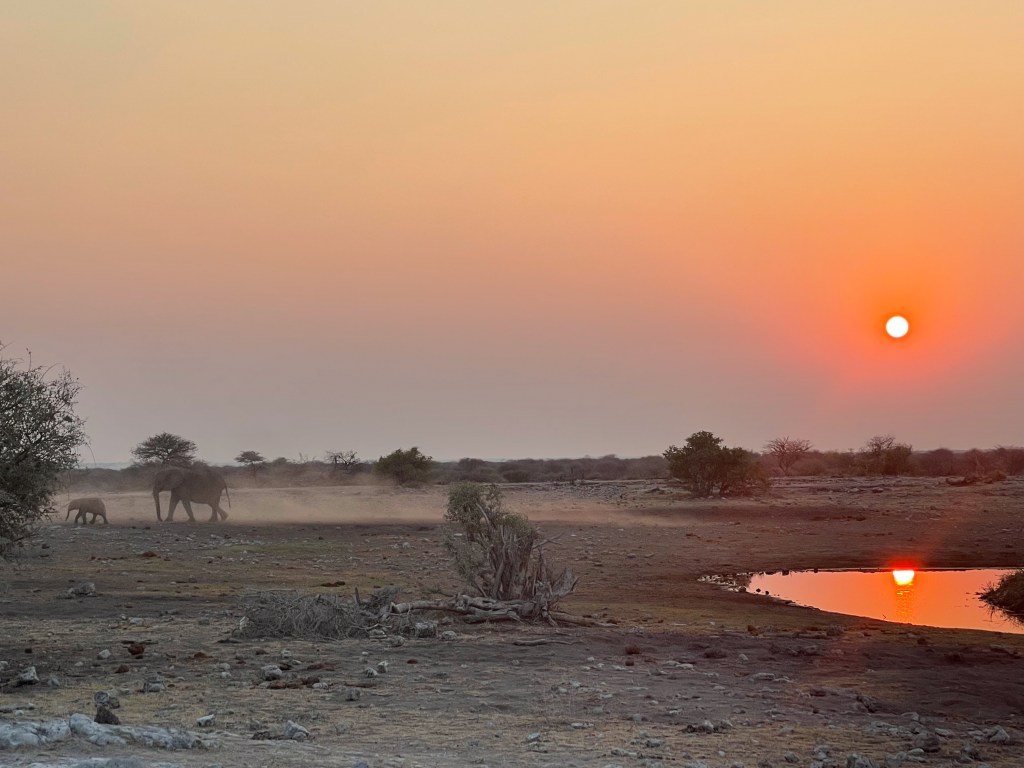
The car park is elevated above the waterhole on the eastern edge, which gives you a fantastic view of the sunset. We saw a few hyena, and giraffes at the waterhole in the evening, but nothing too exciting was happening.
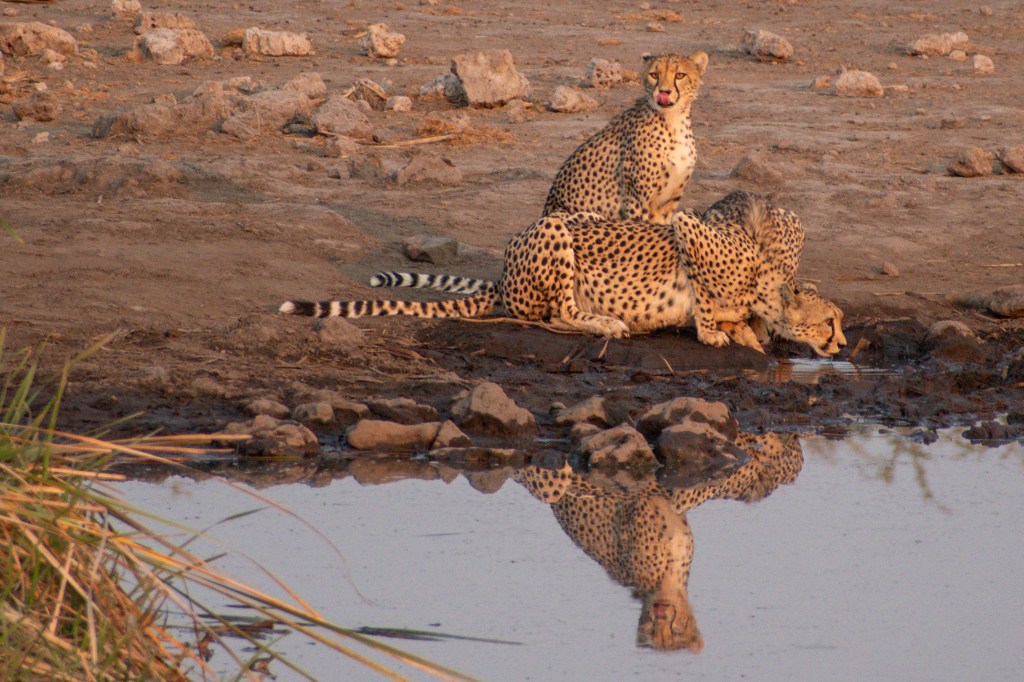
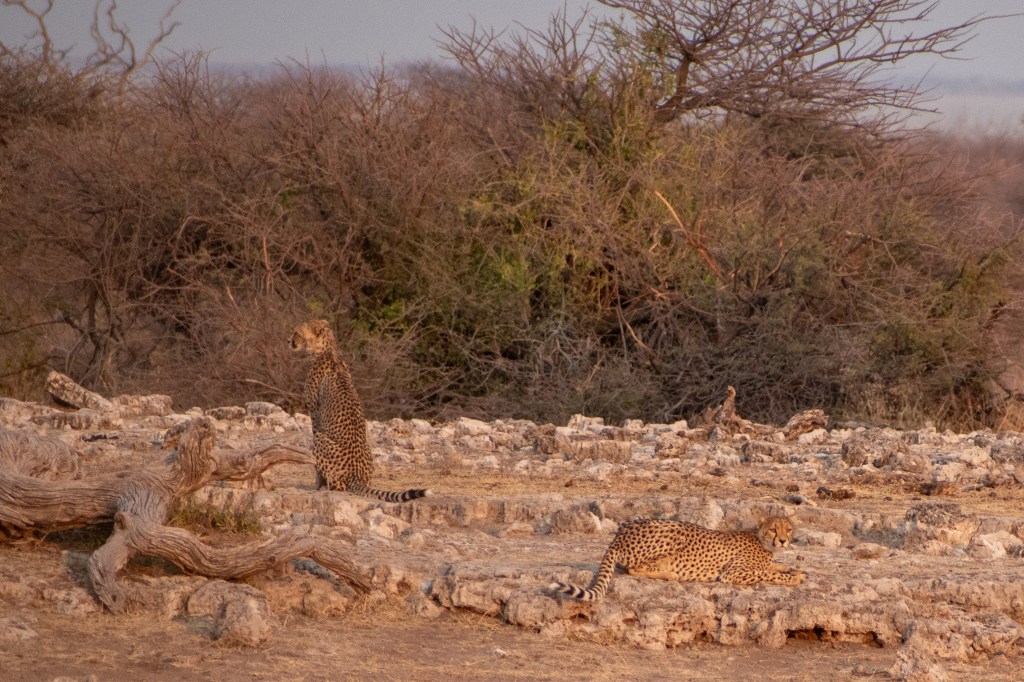
In the morning we were lucky enough to happen across three cheetahs playing by the water’s edge. Within 5 minutes they had moved on, showing how lucky we were to catch them there. Such an awesome sighting means it just has to make it into our top 3.
#2 – Goas
When leaving Halali Camp at sunrise there are many options. Given that the first hour of the day is best for viewing predators, a good slice of luck is required.
Goas has a reputation for being a great place to spot leopard, and when setting off first thing this is definitely what we had in mind to spot.
Conveniently located for Halali camp, it’s only 20 minutes away, and one of the closest waterholes to the camp.
As luck would have it there were no leopards awaiting us at Goas when we arrived. Instead there was a single safari vehicle (National Park guided tours get to leave camp before sunrise) parked up at the far waterhole.
Goas is a two-for-one deal, there’s a waterhole right as you turn off the main road, but there’s also a second waterhole, reached by an extremely bumpy road around the back.
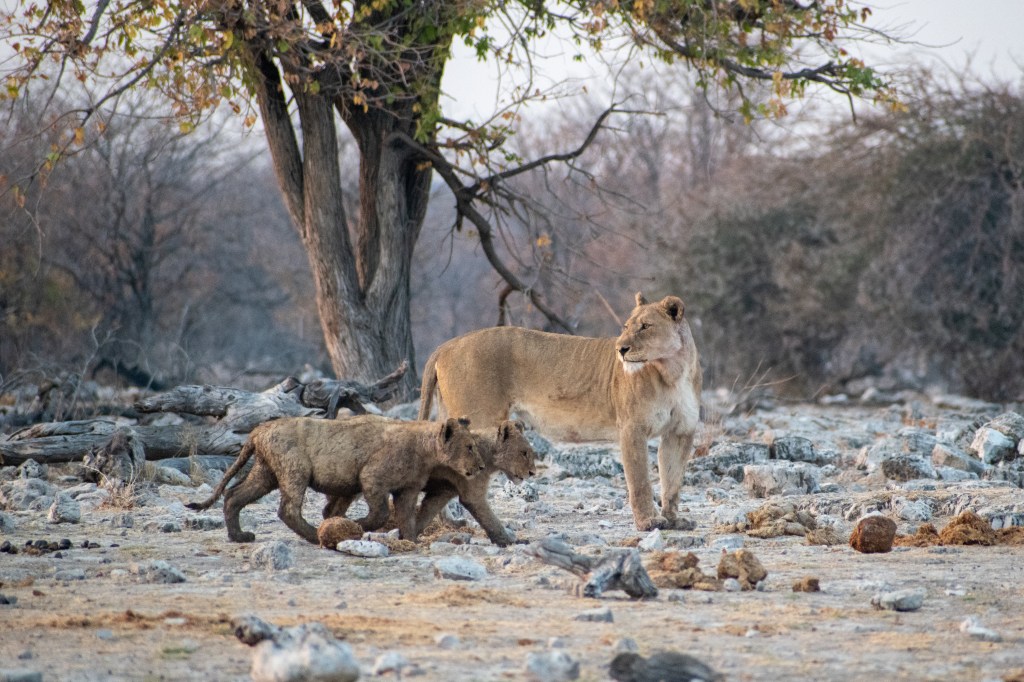
At this second waterhole there were four lion cubs playing down by the water’s edge, whilst their mothers looked on. An unbelievable stroke of luck, or an unrivalled location for spotting predators? Either way it’s #2 on our list.



#1 – Moringa
Moringa is the in-house waterhole at Halali Camp. There is a pathway due-south from the camping area, which takes about 5 minutes.
Uniquely this waterhole is a 24 hour affair, and the best viewing is to be had at night, when the whole scene is floodlit. Don’t forget your torch for the walk.
There is a covered viewing area with plenty of seating, but bring your own snacks because you’ll be here for a while.
But why? How do you top big cats?
Six Black Rhino – in the same place, at the same time. We spent a couple of hours completely captivated by the scene. A herd of elephants tried to disrupt them, and shoo them away, but the rhinos stayed around the whole evening.
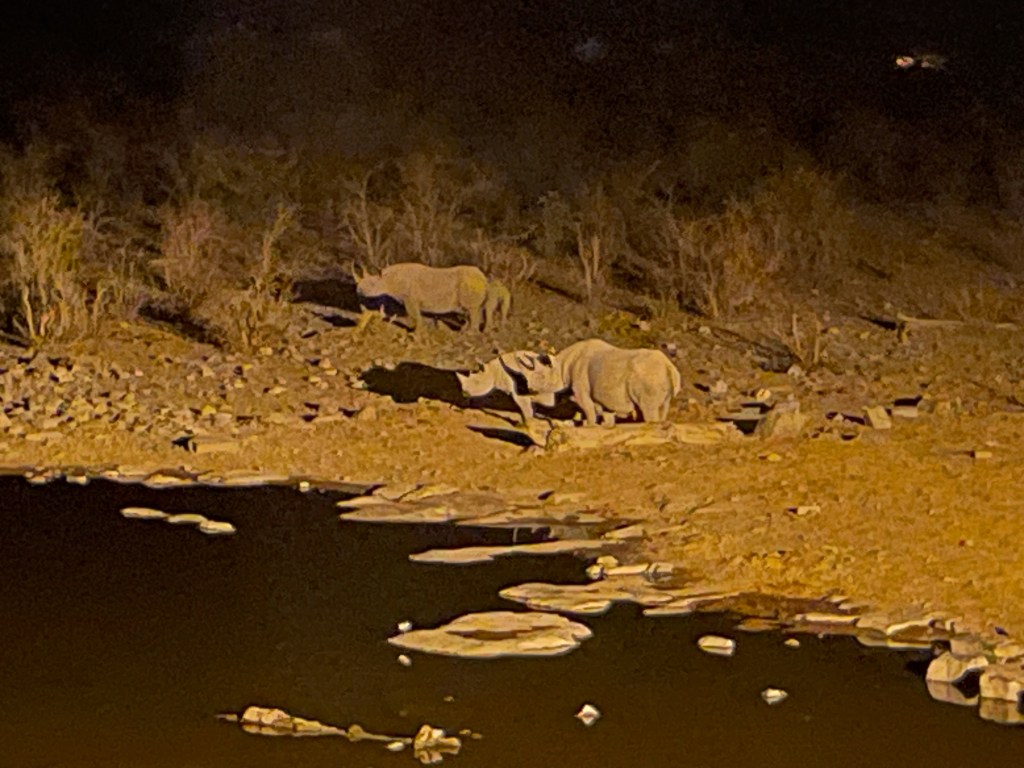
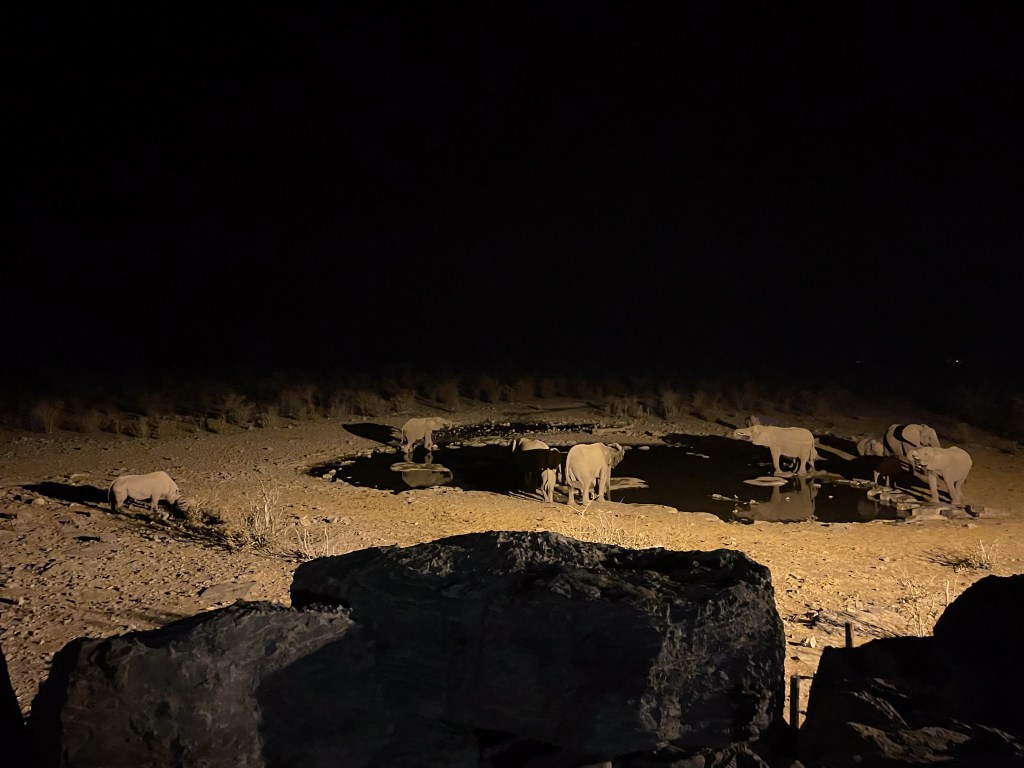
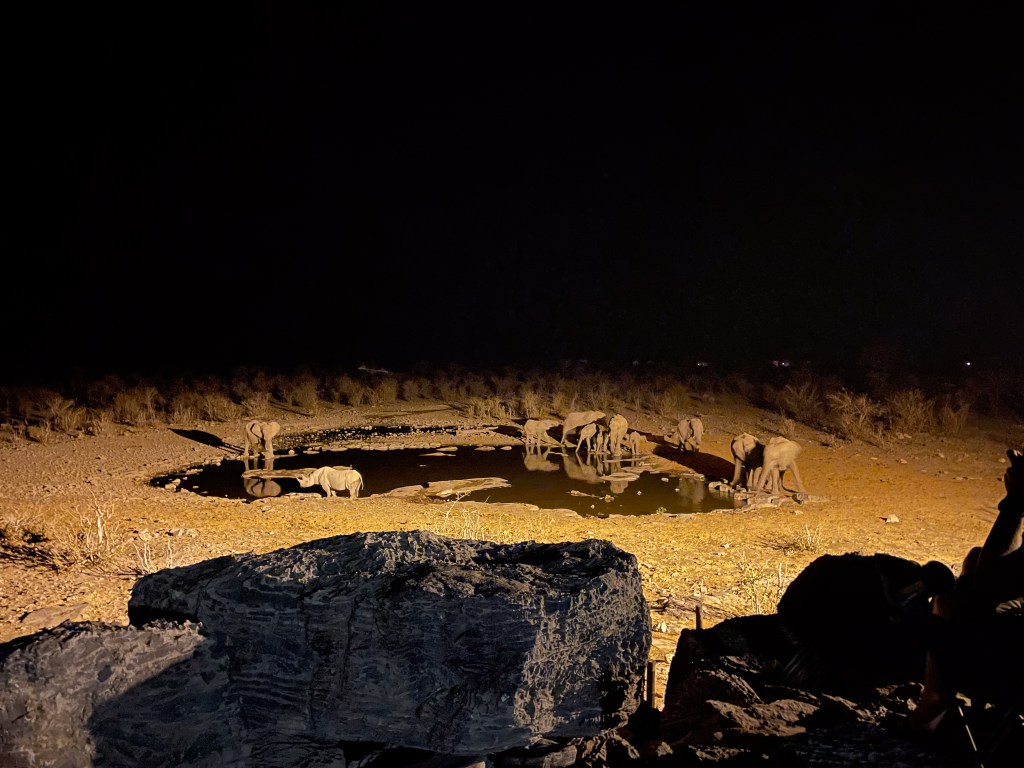

Moringa is renowned for it’s excellent black rhino viewing. These majestic animals are critically endangered with only 5,000 or so left in the wild. They’ve been historically very difficult to understand, solitary by day, black rhinos interacting as a group has seldom been observed let alone understood. We were lucky to witness something truly special.
Sadly rhinos both black and white are sought after by poachers. Their horns fetch unbelievable sums of money in east asia. Fortunately they are thriving in Etosha, and the best way to view them is at one of the floodlit waterholes at Halali or Okaukuejo during the dry season.
Visitors should still be careful not to tag sightings of rhinos incase it alerts poachers to their presence. On our visit, we saw no less than 10 Black Rhino, and a solitary White Rhino. It has been many months since we were in Etosha, the seasons have changed, and the rhinos will no doubt have moved from where we located them. So we feel it’s now safe to share where we saw them, although no guarantees they will be there when you visit.
So that’s our list – do you agree or disagree? What did we miss?
*disclaimer we did not visit every possible waterhole, nor could we be there at all of them at the optimum time for game viewing. The list is not definitive, just a snapshot of our experience.
Map
Honourable Mentions
Because we couldn’t quite visit them all, here’s a quick round up of what we missed, and whether you might have better luck.
Okaukuejo
Famously even better than Moringa, we sadly only visited briefly during the hot afternoon sun.
At night the place comes alive and is the most feted of the three floodlit waterholes in Etosha.
Accommodation in Okaukuejo was fully booked when we made reservations, and therefore we are unable to pass judgement on the nightlife
Chudob
A big wide area with a classical looking waterhole. Game was sparse when we visited save for a small family of Banded Mongoose.
Only 15 minutes from Namutoni camp it was our #1 target for an early morning game drive from Namutoni. We left empty handed from a very quiet waterhole. Known to be better than this, we just got unlucky.
Klein Namutoni
A huge car park next to a very large waterhole. The highlight for us was the Dik Diks which line the road up to the waterhole. The sightings book at Namutoni camp had indicated it had been good for leopard in the preceding days, although we had no such luck.
Super convenient for Namutoni Camp as well as the Von Lindequist gate – so I can see it getting busy on a good day.
Groot Okevi
A detour north of Namutoni, we spotted a lone white rhino on our way there near the causeway across Fischer’s pan. It’s only 10 minutes away from the camp, but sadly it was dry. Lots of very beautiful looking Kudu amongst the trees on the side road, so worth a brief mention.
Ozunjuitji m’Bari
Roadworks on the main road right by this famous and unpronounceable waterhole meant there was no opportunity to visit. Dusty and noisy there was certainly no wildlife to speak of nearby.
Kalkheuwel
An intriguing little bathtub a few kilometres off the main road. We watch a hyena take the plunge and an elephant come to scare him off. Tales of good sightings abound, however our mid-afternoon visit was quiet.
Etosha Pan Lookout
Not a waterhole and no wildlife, Etosha Pan is a slamdunk must visit place just to appreciate the scale of the salt pan. No animals venture out into the open here, so it’s safe to leave your car and walk around. Within a couple of minutes you’ll want to climb back in, the midday sun is hot, and if I were you I’d save the cooler hours for game viewing.
- #10 – Kilppan
- #9 – Okondeka
- #8 – Aus
- #7 – Olifantsrus
- #6 – Tobiroen
- #5 – Rietfontein
- #4 – Salvadora
- #3 – Koinachas
- #2 – Goas
- #1 – Moringa
- Map
- Honourable Mentions
 Small Holiday Big Dream