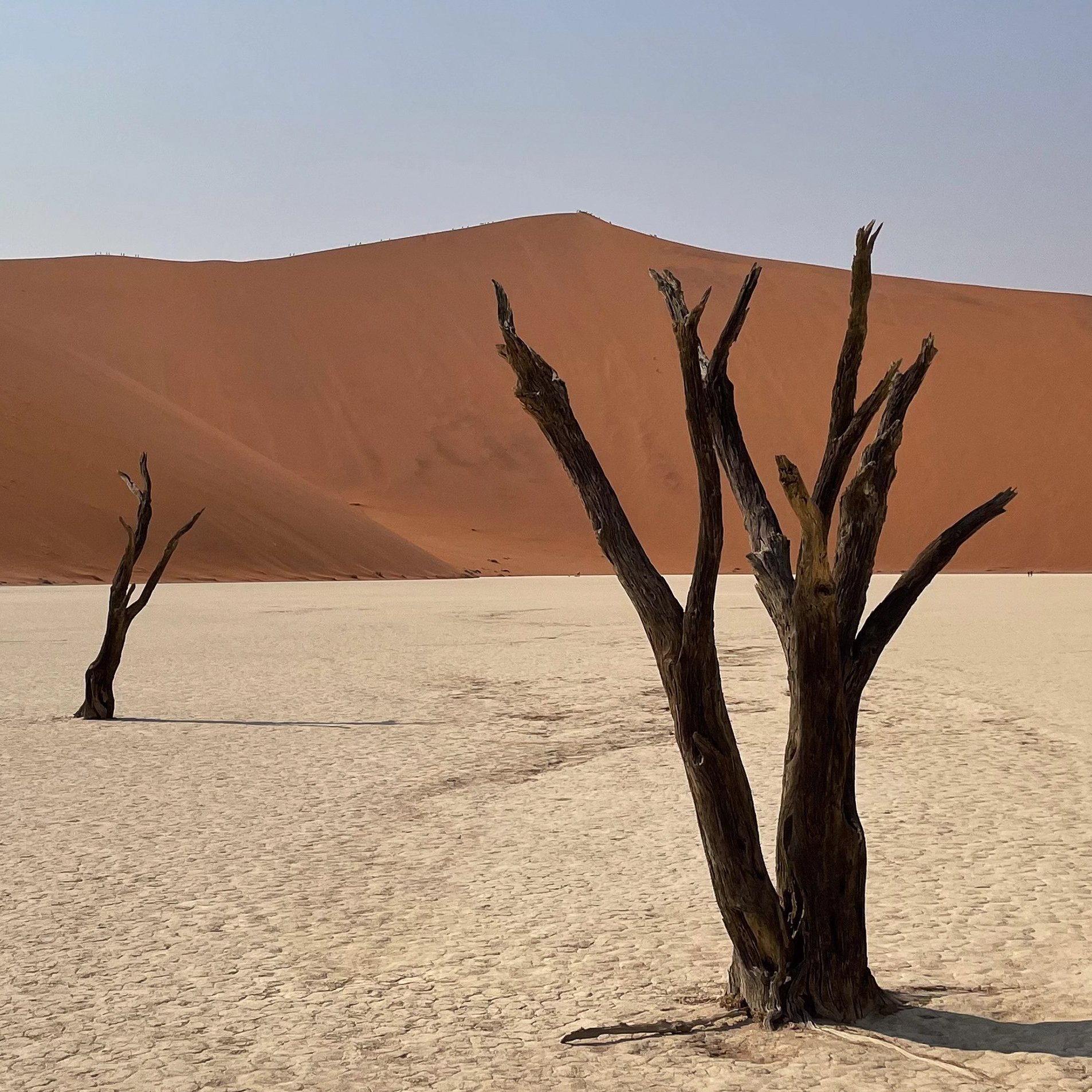
Etosha National Park is the crown jewel of any trip to Namibia. In many aspects it’s an unrivalled safari destination and is uniquely suited to a self-drive trip. With a few handy hints and tips any traveller can have an incredible time and catch some truly unique sightings. Here is our short guide on how to get the most from your visit.
- Introduction
- Map
- When to visit
- Etosha Do’s and Don’ts
- Accommodation
- Top 10 Waterholes
- Our Favourite Sightings
Introduction
Etosha has to be the number one self-drive safari destination in the world. It’s relatively straightforward to organise your own trip there, and witness some of the most extraordinary wildlife.
Etosha is truly enormous, many things are compared to the size of Wales - but Etosha is even larger. Today, it covers an area of approximately 22,270 square kilometers (8,600 square miles) - numbers mean sod all, but that is indeed bigger than Wales.

The park is dominated by the huge salt-pan, one of the largest in the world. In wet season it turns into a giant mirror and becomes home to thousands of flamingos, not unlike other famous salt-pans. During the dry season the pan is a desolate place. No animals venture out onto it, and it's one of the few places in the park you are permitted to get out of your car for a photo opportunity.
Map
To help get your bearings – Etosha National Park is in the middle of the North of Namibia. Around 400km north of the capital Windhoek, from which it will take roughly 5 hours to drive to the closest gate. (Rule #1 – for accurate driving times add 20% to google maps)
There are three main gates you would likely use for access. Galton Gate on the western edge of the park in a sparse and relatively unpopulated area. Andersson Gate on the southern edge roughly centrally is ideally located for Okaukuejo – the main camp in Etosha. And Von Lindequist gate on the eastern edge of the park, nearest to Namutoni and will be useful if accessing the park from Grootfontein, or the Caprivi strip. A fourth and final gate on the northern edge of the park gives access to those coming from Ovamboland.
Game viewing in the park is the main attraction, and any itinerary will centre around the numerous waterholes which attract animals to drink from far around. This is much more pronounced in the dry season.
The map includes our top 10 waterholes, locations of key camps and entry points, and of course the locations and photos of our best sightings whilst in the park.
When to visit
Dry Season is from May to November over the winter months. During June it can get surprisingly cold overnight, heat will begin to build in August through September. by the end of October it will be unbearably hot and humid with animals and humans alike desperate for the rains to break.
Wet season is from November to April, during this time it is hot and humid and there will be frequent downpours. Wildlife will be more dispersed and less dependent on waterholes.
The optimum time for wildlife viewing, and in particular the big game, is from June-September. It is no coincidence that the park will be busiest at this time and booking accommodation in advance is crucial.
Birders would be better served seeking out the wet season when the salt pan comes alive with migratory species.
Etosha Do’s and Don’ts
- Don’t get locked out of camp
- Do be patient at a waterhole
- Don’t take red meat out of the park
- Do book all accommodation in advance
- Don’t worry about driving
- Do be well researched before arriving
Read more detail here:
Accommodation
Inside the park there are a few permanent camps to choose from. You must book these in advance via the NWR website, and you are not permitted to wild camp.
The gates on the camps open at sunrise and close at sunset, the times are posted clearly on the gates of the park, and on the camp gates themselves. You must be inside the gates before they close.
Camping is available at four locations, from West to East these are:
- Olifantsrus
- Okaukuejo
- Halali
- Namutoni
In addition there are two more luxury accommodation options. Dolomite camp in the East, and Onkoshi camp in the West.
Top 10 Waterholes
The real treat with Etosha is the ease of conducting your own self-drive safari. The wildlife often congregates at the permanent waterholes, and these locations are well signposted and super accessible. Parking for optimal game viewing is straightforward, and sightlines are very clear, especially in the dry season.
Animals will come and go as they please, often the biggest joy is to just sit and wait and watch what will emerge from the bush next. It really is that straightforward to have some fantastic sightings of rare and wonderful species.
All you have to do is carefully select which waterholes to visit. But we’ve made it easy; read our guide on the top 10 waterholes in Etosha
Our Favourite Sightings
We were fortunate to catch a glimpse of each of the big cats in the area; Lions, Leopards, and Cheetahs. However the star of the show must be the Black Rhinos. During our time in the park we spotted no less than 11 of these magnificent and elusive creatures.

 Small Holiday Big Dream
Leave a comment