Of all the trip, this was the part we were most nervous about. The sand of the Central Kalahari, the Solitude of Liuwa Plains, crossing the North Luangwa, or the back route into the Lower Zambezi, all pale into insignificance when paired with the challenge of the Binga-Karoi road.
To reach Hwange, and Camp Silwane we had two days. Which meant a one-night stopover somewhere along the road. During planning the suggestion was Chizarira gorge, or perhaps the Matusadona national park gate. We now know we should have given each of them at least a few days. Both places meriting much more than just a stopover. The planning faux-pas is not a problem, we will just have to return in future.

To set the scene, we were still at Nyamepi, on the banks of the Zambezi river in the far north of Zimbabwe. Our destination was Hwange National park, nestled into the North Western corner of Zim, to the south of Victoria Falls.
The most three most popular routes of traveling between the two places are:
- Plane – small passenger planes plying the expensive safari trade. If you buy a package Zimbabwe safari visiting Mana Pools and Vic Falls, you’ll probably be sent in one of these.
- The long way round via Bulawayo and Harare – and why not? The roads will be tarred.
- Ferry – for the princely sum of a few hundred dollars you can buy a ferry across lake Kariba. If you make friends then the cost can be shared. You will also need many days. If you’ve got an Amazon backed production budget then buying a boat is an option.
Quite like Jeremy Clarkson and co, we had assumed driving around the southern shores of Lake Kariba would be possible. We even thought it might be pleasurable. However, before departure to Africa, we had access to the internet and a map.
Google optimistically estimates 12 hours to drive the 700km from Mana Pools to Hwange. The majority of which is slow going on gravel roads, and the remainder even slower on exploded tar.
Furthermore, there’s a complete lack of accommodation on the route. The only viable option on iOverlander appeared to be an abandoned campsite at the Senyati Bridge.
Undeterred, and with a lack of alternatives, we set off from Mana Pools.


Karoi
By lunchtime we had reached Karoi, the largest town we had visited in Zimbabwe. In reality for us it was just a supplies stop.
At the Puma fuel station just outside town, we filled up the tank and paid with a crisp US$100 note. We had brought plenty of cash to ensure we wouldn’t run out as we knew cards would not work at all in this country.
Albert, the fuel attendant, was a die-hard Arsenal fan. We had no Arsenal pens to give, so he took a Southampton one, and Mike’s whatsapp number. He promised to message every time Arsenal played Southampton, a promise which he has kept to date.
Pick ‘n pay was the supermarket of choice in town. We parked right outside the bustling entrance. Prices are a good percentage higher than elsewhere in Southern Africa. In some cases luxuries were eye-wateringly expensive. We had to forego a £6 tub of greek yoghurt because neither of us could face spending so much.
Sarah was approached by the locals, offering to pay for her shopping via swipe (card). The exchange rates to the new Zimbabwean currency the ZiG were plastered on the walls of the shop. US dollar notes are more likely to hold their value than a currency a few months old, so we can see why the locals would offer. We also managed to secure a couple of ZiG notes for our own personal interest.
Meanwhile at the shop entrance Mike was subjected to a photoshoot. It was a young boy’s birthday and he was very proudly holding a large cake. His parents were taking a photo of him holding his cake but, amusingly, encouraging him to shuffle closer to Mike. It was an interesting experience to be the entertainment. Mike did oblige and joined in on the photoshoot.


Dog
The Land Cruiser handles like an oil tanker. Stopping distances are better measured in kilometres. When a dog runs out into the road and freezes, there’s not a lot you can do apart from hit the brakes and hope.
An hour or more west of Karoi, this is exactly what happened to us. It’s difficult to even reach 50km/h on these roads, but even at that speed stopping takes a long time.
We got lucky, despite getting a tap on the side, the dog appeared to be ok, and scurried off into the bushes.
Senyati Bridge Camp
Yet again it was a few minutes before sunset when we trundled into our stopover for the night.
We had no idea what would greet us. An empty patch of land? A busy village? Would there be anyone there at all?
The gravel road plunged alarmingly steeply into the Sanyati river gorge. The road surface viciously corrugated, it was difficult to stop the Land Cruiser sliding. Just before the long bridge crossing the river we took a right turn, and climbed back out of the valley onto a promontory overlooking the river. We pulled into what looked a little like an abandoned construction yard and waited.
This was very much our only option for the night. We don’t particularly like sleeping on the side of the road, mostly because we feel it’s important to contribute to the community and pay our way. There were conflicting online reviews about this location. There were only a handful of reviews to count on, some of them many years old. Some said it was an abandoned campsite and possibly even dangerous. Other more recent reviewers had left more encouraging messages.
At that moment a man jumped up and walked over to the car, he introduced himself as Mereki, the caretaker of the campsite. He asked for US$5 per person and showed us to the campsite.
Overlooking the Sanyati gorge were are a couple of beautiful thatched rondavels which had been recently re-thatched and painted. Mereki told us the campsite was being renovated, and work was almost complete. We could camp in the clearing and he went off to fetch us some firewood.
The view over the valley was spectacular. We watched and waved to the people on the riverbed. They were working, walking, and playing. The sky turned orange behind the hills to the west.
Signing Mereki’s guestbook, it was a shame to see the place was visited so infrequently. We were the fourth group of visitors to come by in July. He had had four visitors in May, and a handful earlier in the year. It’s saddening to think Mereki sits there all day every day, waiting to see if somebody will turn up. Today was a lucky day, for us, and Mereki.
Now known as Rengwe Conservancy Campsite – the place is open and ready for many more visitors.


A long way to go
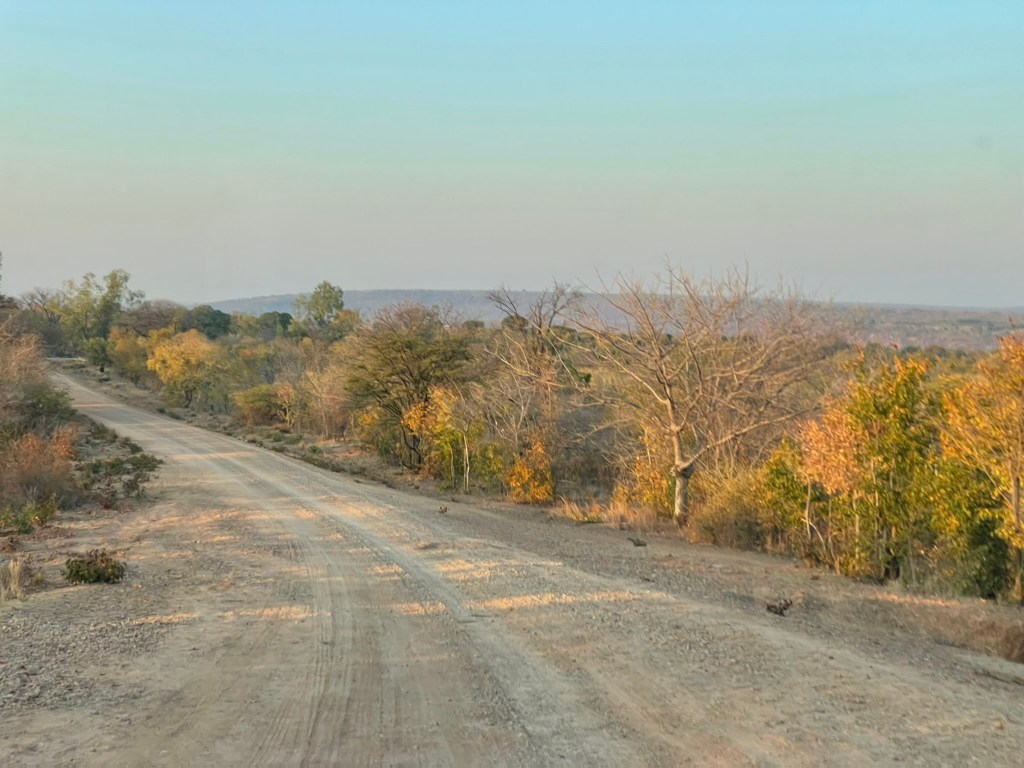
We left as soon as it was light enough to see, meaning it was still very much dark. The gravel road was indeed in bad shape. An hour or so into the day there was a particularly long stretch of very sandy and corrugated road. It was still recognisably a road though, and we made good progress.
Four and a half hours later we reached the Binga junction. The tarmac had begun. Unfortunately that didn’t mean quicker going. The Land Cruiser thrives on gravel and, except for a brief moment where we were airborne near Siabuwa, the terrible gravel road was mostly smooth sailing.
Exploded tarmac is a leveller. Potholes you could lose a small hatchback in would creep up without warning. Within ten minutes we were desperate for the gravel to return.
Somewhere near Mlibizi we stopped at a roadside stall selling wooden knick-knacks. Beautiful hardwood chopping boards and bowls were hard to resist. We’d barely seen another car, let alone any tourists, so trade was hardly roaring. The sales patter was stilted, but we were grateful for the stop.
From then on souvenir stalls appeared more frequently. It was great fun watching as the products changed with every hour on the road. Small bowls gave way to enormous two-piece rosewood chairs. Hardly practical for luggage. Quite comically the intricately carved chairs began to be replaced with full sized axes. Nothing seemed quite appropriate to stop and buy.
By 13:30 we were at Dete crossroads. 350km at a spritely average of 45km/h. Way ahead of our expectations.


Painted Dogs
We were ahead of schedule, which meant we had enough time to pop into the Painted Dogs Conservation Centre on the way to Hwange Main Camp.
Well worth a visit if you’re on your way to Main Camp. There’s a free exhibition following the life of Eyespot (not Icebot). African Wild dogs are at risk of snares laid by poachers and these can be catastrophic for their population. The charity does a lot of work in Zimbabwe to protect the dogs, and to educate the locals. By most measures they are being successful. Hwange is now known as a stronghold for an endangered species under extreme threat in most of Africa.
There’s a small rehabilitation pen where we could visit the inpatient dogs. Being the middle of the day they were hidden away in the shade.


Silwane
Camp Silwane is just outside Hwange National Park. However to get there you have to enter the park, and buy permits, at Main Gate. Then drive through to Kennedy gate. We maximized our park fees by game-driving all afternoon. We exited the park at the stroke of sunset.
The temporary camp manager at Silwane gave us a bit of a frosty reception. Possibly put out by the fact that we’d arrived after dark. Although she was just a generally miserable old lady who’d lost the excitement for her day job. She showed us the way to the campsites, which were a good 10 minute drive from the lodge. They felt isolated. Perfect.
It was a shame she was so grumpy because Silwane Camp is an excellent campsite, a wild and secluded site on the very edge of the national park. There are a couple of camping spots, both complete with their own private waterhole. The platform camp is most impressive, the opportunity to stay up in an open treehouse of sorts, overlooking the waterhole. It was fully booked, so we had to make do with the less impressive but still excellent Hammerkop site.
After a long day of dusty driving we treated ourselves to a bucket shower. For the uninitiated, a couple of big buckets of water are heated on an open fire. Once hot the water is poured into another bucket which is hoisted up by a rope. This bucket has a shower attachment on the bottom. Standing under the hot stream of water out in the open is a refreshing experience. If you close your eyes you could be in a luxury safari lodge.
The now familiar sounds of lions’ co-ordination calls filled the air. One of which sounded particularly close. It is unsettling to have a lion just around the corner, whilst trying to have a shower out in the open. We kept a close look out, but he wasn’t quite close enough to put us off our showers and dinner.
Later in the evening a new sound filled the air. A train pulled past the Kennedy gate. 750m away from us, it felt like it was just next door. The train seemed to spend the night in the sidings by the National Park entrance. The railway line here goes on up to Vic Falls. Expensive first-class holidays are the main users of this line. For a few thousand pounds you can spend three nights chugging between South Africa and Victoria Falls. Pretending you’re on the Orient Express and stopping for a safari on the way.


 Small Holiday Big Dream
Leave a comment