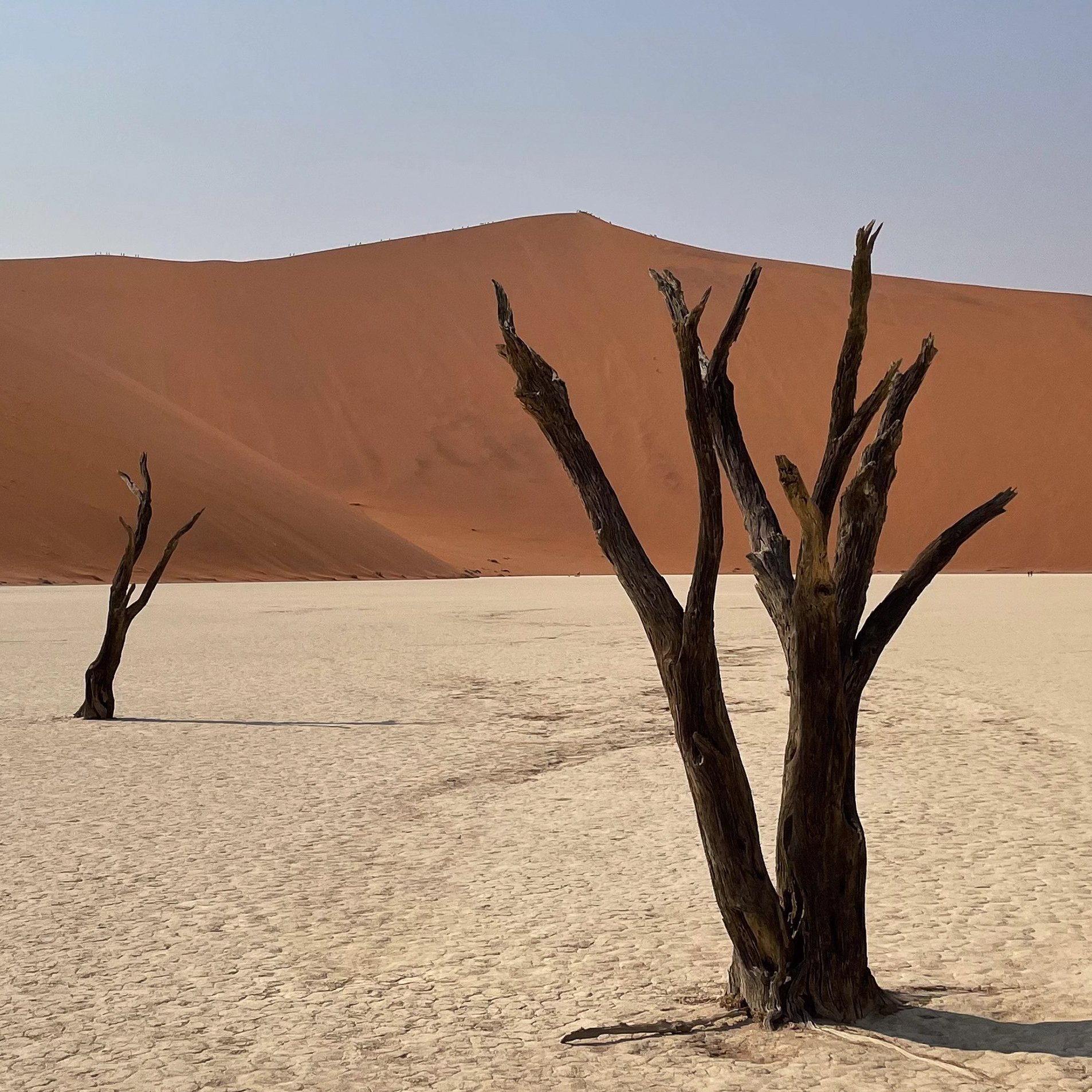
Currently we are in Katima Mulilo enjoying a slap up breakfast. The first real stable wifi connection we have had since leaving Johannesburg. Botswana is fantastic, but we just went to some very remote areas. Here is an account of the five nights we spent in the Central Kalahari a famously remote and inhospitable tract of land bang in the centre of Botswana.
I’ll update other blogs soon. I’m sure you’re keen to hear about the Galápagos Islands, and our brief visit to London, but this should be more interesting to start.

Entry into the CKGR
Today there was no game driving to be had, so a lie-in in the tent in Rakops was on the cards.
Today we drove into the Central Kalahari Game Reserve. One of the largest slices of protected land in all of Africa. There is precisely nothing here in an area the size of Switzerland (or a couple of Wales). If you read, or in our case listen to, ‘Cry of the Kalahari’ by Mark and Delia Owens, they bang on about how it’s the size of Ireland. Each to their own.
The Game Reserve was made semi-famous by the book, and now receives the grand total of a handful of visitors a year. There are maybe 20 campsites dotted around the reserve, most of them many kilometres away from each other. By campsite, we mean a site for a single group, with a pit toilet and bucket shower. There’s no running water inside, you must take everything you need, and bring everything back out again.
Two hours was the drive from Rakops to the Matswere gate. You turn off the main tarmac road onto a sandy track striking out into the desert all alone. Yet 500m after leaving the road we came across two stranded vehicles in the sand. Their occupants must have walked back to Rakops to seek help. One of the cars was the same 2WD Isuzu pickup that we rescued in Khama. We couldn’t help but wonder if it was the same group. If they had stranded two vehicles less than a kilometre from the town, there is no way they should be heading out to the Central Kalahari. I think they dodged a bullet.
The road to the CKGR was indeed quite bad in places. Plenty of deep white sand to get stuck in. Luckily our Land Cruiser had no problem at all with the route. In fact there were only a few small sections where we needed 4WD, for most of the journey we left it in 2WD.
At Matswere gate we had some negotiating to do. Because of a mix up in the bookings we had a couple of extra days to blag. We had arrived for a five night stay, although we had only booked and paid for the final three nights. The ladies on the desk were cheerful and accommodating and we managed to secure the extra two nights we needed at Deception Camp.
Deception valley is a further two hours from Matswere gate. The flat xeric scrubland of the Kalahari is endless, with only minor changes in vegetation to keep your interest. After two hours the bushes end abruptly and a vast open grassland opens up. It’s pancake flat, and you could probably land a plane down the middle of it. Just across the valley was our camp for the night, we headed straight there to make some lunch.
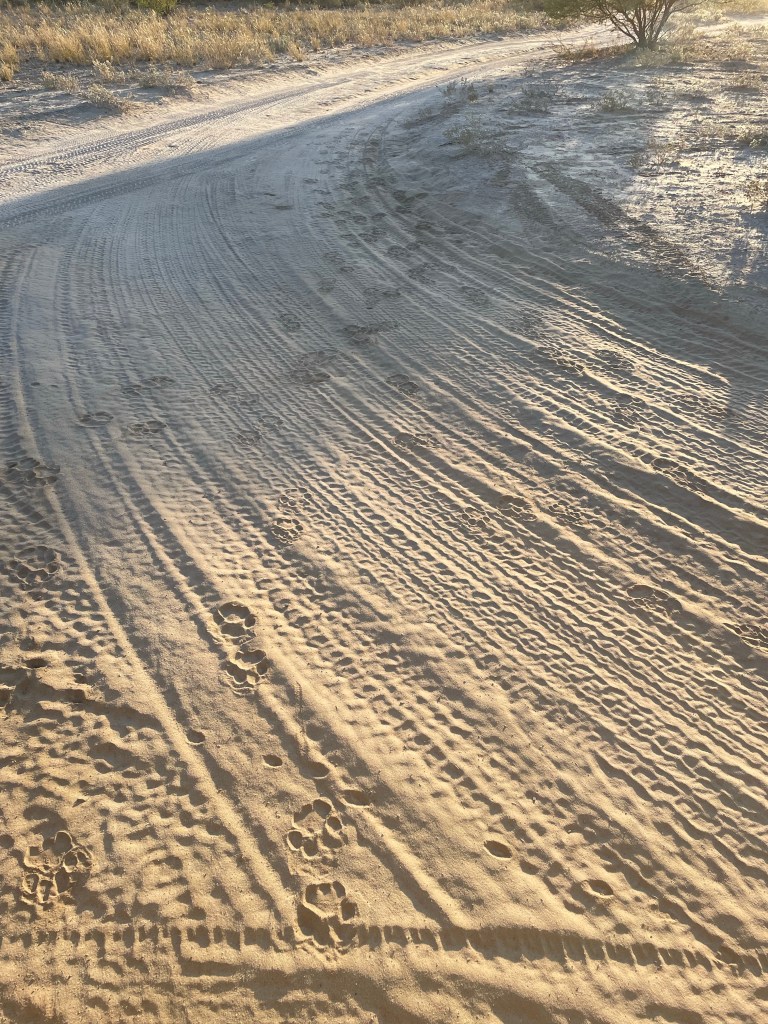
We chatted to a couple staying at a nearby campsite. They had been in the reserve a few days, and it had been very quiet on the wildlife front. That said, just next to our campsite we came across the paw prints of an enormous lion, not fresh, but only a few days old. The famous Kalahari lions were close.
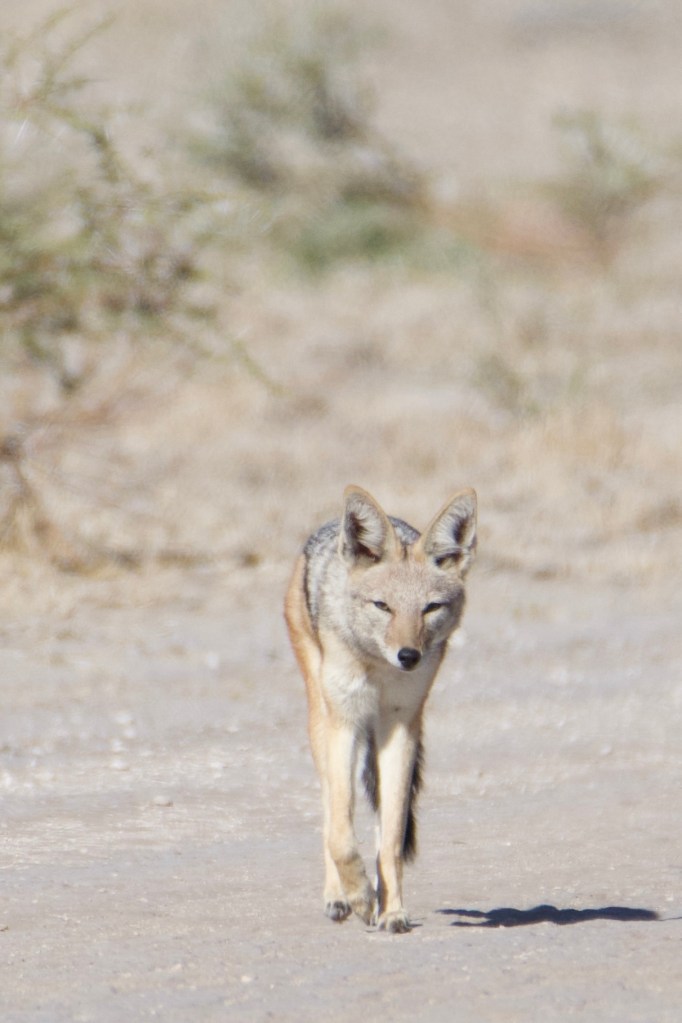
In the evening we headed out into Deception valley. Many Kori bustards roam out in the open. We wondered whether anything would prey on these massive stocky birds, but there was little in the way of excitement. As we were driving along the open plain we both spotted a twitch of a tail to our left. There just 30m o so off the track were two snoozing bat eared foxes. These cute little foxes with their enormous white fur lined ears always hang out in pairs. It took us a while to spot the second, just a couple of metres away from her companion, yet almost camouflaged against the dusty valley floor.
Night came back at camp, the moon was nearly full and visibility excellent without a torch. We were prepared for any animal visitors but none would come. (Except for the Red Billed Spurfowl seeking moisture from our discarded dishwater, and the Crimson breasted shrike who lived in our tree).
Camping in Africa, the night is usually filled with the sounds of the bush. Here in the central Kalahari it was unearthly silent.
Distance: 92km
Cumulative Distance: 1,082km
Deception Valley and Sunday Pan
The night had been very quiet, absolutely nothing had come through overnight. In fact nobody at deception camp had heard a thing, and we all considered this unusual. Life in the central Kalahari is sparse.
10 minutes before sunrise we sped out of camp. Our target was Sunday Pan, 16km away and the only water source for a huge radius of tens of kilometres.
Arriving at the waterhole was a slight anticlimax. Three Oryx gave us their signature nonchalant stare before returning to their drink. A couple of kudu were also present, but none of the famed Kalahari predators.
Around the western side of the waterhole we caught some fresh lion tracks. We followed them south, but lost them as they moved away from the water. Circling back to the northern side of the pan we were amazed to see the tracks of a whole pride of lions. Our best guess was five animals, but at least four for certain, and possibly more.
We managed to track them south east from the waterhole, all the way to the end of a dead end track. The lions, just as frustrated at the road ending, headed south. We could not follow more than a few hundred metres off road. The lions had won the day, we couldn’t get a sighting.
We returned to the open plain of Sunday pan, brewed some tea and had breakfast. In the distance a large number of giraffe were grazing the tall trees around the edge of the pan. In the middle of the pains we saw five bat eared foxes. A couple of them were play fighting, the rest sleeping. M
After breakfast we returned to the waterhole once more. We decided to trace the Lion’s footprints backwards. They had come down the hill from Sunday Pan Campsite number three. Frustratingly we had requested Sunday pan camps at the park gate and were told they were full. Nobody except the lions was here last night.
We moved across to Sunday pan campsite two, where we met a lovely South African couple Cecilia and Mark and their two young daughters. We mentioned the pride of lions had passed barely 100m away last night, but they insisted they didn’t hear a thing.
By now it was the middle of the day, we headed north to leopard pan, to have lunch under a tree and look out over the grassland. Wildlife in the CKGR was sparse, and I. The heat of the day nothing but kori bustards roamed the open land. Occasionally an Oryx or Springbok would come into view, but even they sought shade at midday. A surprise sighting was a black-headed heron. Many kilometres away from any water he was surely lost. A common sighting in many places, but here it must be rare.
We headed back to Deception Valley with the intention of taking a break at camp. By the time we got there however it was already 3:30pm and we considered it best to just continue on our extended game drive. We headed south to Deception Pan.
There wasn’t much time to enjoy deception pan, but neither was there much to enjoy. A circular slate gray pan, dry as a bone, and a complete absence of any movement. With no animals to be spotted we trundled back north into deception valley in the hope of making our camp by sunset.
In places the track is deeply rutted, indicating that it clearly does get very wet here at times. Many a vehicle has clearly been stuck in the mud here. The days of deception valley holding a river are long gone, 16,000 years since this was a permanent watercourse. All that’s left now is the remains of a riverbed, a wide strip of grassland bisecting the expanse of shrub covered sand dunes of the Kalahari.
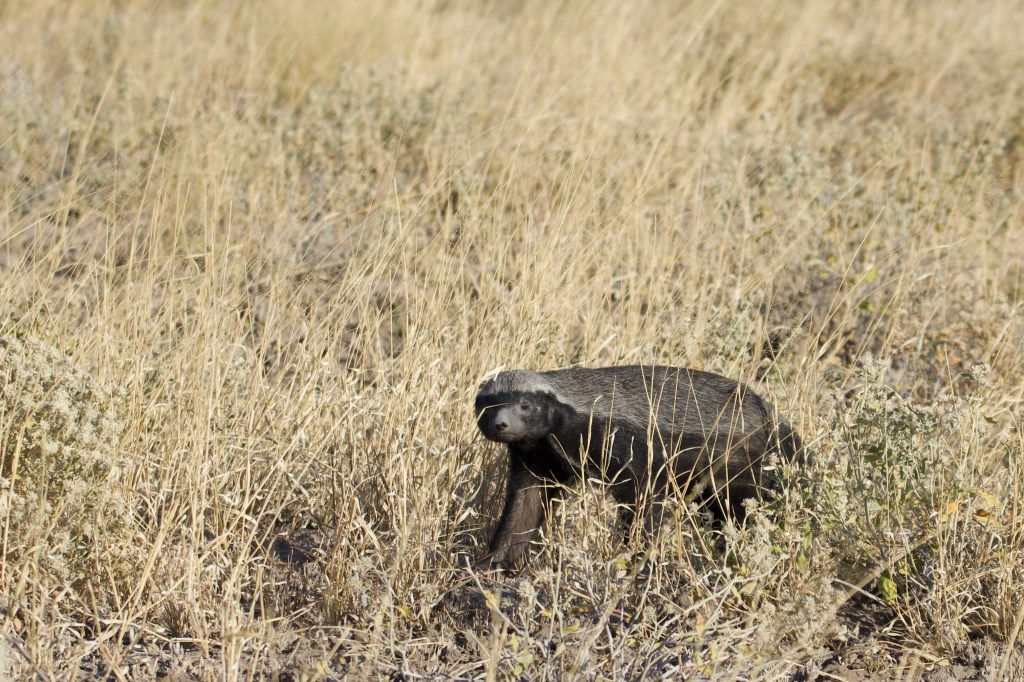
On the way back to camp we spotted a honey badger, busying himself in the distance. He was amiably followed by a goshawk, somehow the two must be working in tandem.
Back at camp the familiar silence greeted us, and stayed with us til dawn.
Distance: 90km
Cumulative Distance: 1,172km


Passarge Valley
Out before dawn, we made haste to Sunday pan to track down the pride of lions. In the night they had been on the road between deception camp and Sunday pan. The fresh tracks left the road to the west half a kilometre south of the grasslands of Sunday pan. We headed quickly up to the waterhole, but no luck, the pride had not yet returned. We tried all the loops and camps around the southern fringe of the area, but the lions had vanished.
A helpful guide from Bush Lark safaris corroborated our findings. The lions had gone down between Sunday Camp 01 and the southern loop. But with no more roads we were again out of luck. We were left with bat eared foxes, oryx and kudu as the only sightings of the morning.
Today we were heading over to the western side of the CKGR, through Passarge Pan, to our overnight camp at Passarge 03. We had plenty of time to make the drive, so we had a relaxing breakfast near the waterhole at Sunday pan. Before leaving the area we dropped back in on Mark and Cecilia, just to warn them that the lions were near to the camp they were moving to this afternoon. They’re a very bush smart family, so I don’t think they needed the warning. They told us about how at their last camp in Mabua they had lions come through in the evening. They also told us about a Leopard attack at Bosobogolo, which may be a reason why our Mabua bookings were invalidated, although we still chalk it up to DWNP incompetence.
Passarge valley is the northern part of the CKGR loop. It’s another spectacular strip of open grassland between the wooded dunes. Islands of acacia trees break up the landscape. Much of the driving between these valleys and over the dunes is quite monotonous. The vegetation changes only subtly, and visibility for viewing animals is practically zero due to the densely packed bushes and trees. Out in the open of Passarge valley driving is much more pleasant. Firstly the ground is baked fossilised riverbed, so driving becomes easier. Secondly stopping and scanning the landscape for movement yields slightly more wildlife. That is: some, instead of zero.
African wildcat!
Giraffe lying down
And two honey badges digging around in the afternoon sun.
Our camp at Passarge 03 was deserted. Nobody else within 20km. There was no wildlife either, except a mouse who popped his head out after dark. Sarah left him a piece offering of a chunk of sweet potato in exchange for not chewing through the wires in our starter motor. The full moon rose at sunset in the most spectacular fashion, and we braaied in peace, except for the mouse.
Distance: 96km
Cumulative Distance: 1,268km



Passarge Pan
This morning we had a lie-in. After yet another completely silent Kalahari night we weee certain no large animals were nearby. We were out of the tent just before sunrise, and made a cup of tea and had breakfast watching the full moon set. The ever frustrating Kalahari surprised again, a bank of cloud on the eastern horizon obscuring the sunrise. At least today the heat built more slowly.
It was a leisurely 8am by the time we’d packed up camp and set off in the direction of Passarge Pan. The mouse had accepted Sarah’s offering and kept up his end of the bargain. We were heading around the main loop of the CKGR in an anti clockwise direction, and today we’d reach the furthest into the park we would venture.
Shortly after leaving camp a leopard track crossed our road, perhaps there was wildlife around after all. A few km away from camp more tracks appeared. This time a large solo Kalahari male lion. The enormous fresh paw prints gave us the impression of a massive beast. We followed his tracks for 3-4km almost all the way to the waterhole at Passarge Pan. As the sand road hardened into the baked clay pan surface we lost the tracks. Circling around to the waterhole we found he was not there. Trying the road north towards Motopi we found more large lion prints. Again fresh, again alone, and again heading back toward the waterhole.
We scanned the area for an hour or so, but to no avail. To the north: only tracks heading back to the waterhole. To the south: two Kudu relaxed under a tree. West there were no prints on the track, and east an enormous herd of 28 Oryx (an enormous herd for dry season at least). The lions had gone down for the day, out of sight.
The roads all the way around the CKGR are littered with fresh tracks. With low vehicle traffic and excellent fine sand, the tracks stay in great condition. Following the tracks and imagining what might be at the end of them is a great excitement. Although disheartening when three days in a row you come up empty handed.
The landscape at the eastern end of the CKGR loop is characterised by a succession of long parallel linear pans, several hundred metres wide and many kilometres long. The only road zig-zags down these pans adding significant mileage. The pans themselves are wadi open spaces, either grassland or bare stony patches of land, punctuated by islands of acacia trees and the odd lone tree. At the sides of the pans the Kalahari sandveld continues. Low bushy trees and thick vegetation on the undulating dunes.
The Kalahari is not as you imagined. There is much more plant life here than you might expect in a desert, it also gets plenty of rain, but concentrated in a short period between January and April. The rest of the year is dry as a bone. Any water drains away quickly into the soft sand or evaporates off shallow waterholes into the hot Kalahari sun. This year the rains were exceptionally poor, and by mid May it’s uncomfortably dry for the inhabitants of the CKGR. In the dry season wildlife disperses and becomes very scarce, it’s a miracle anything lives here at all. The dust is intolerable, it gets everywhere, all the time. It’s impossible to stay clean for even a minute. After a day driving through the reserve everything on the outside of the car is coated in a fine layer of grey-brown muck. At least it brushes off easily.
The cold dry season is here. The next rain is almost seven months away. The temperatures are taking a dive as the days shorten. Leaves are brown on the trees and many trees are already in a winter state, leaveless. The sun is still scorching hot at midday, temperatures climbed to the high 20s or into the 30s. But the air cools quickly, and overnight the mercury reads single figures. Jumpers and trousers are essential for the chilly mornings. The Kalahari is not as you imagined.
The sights for today were:
A Honey badger busying himself in the afternoon sun, digging holes.
Red hartebeest – a small herd scared by our car.
Ostriches – a desert staple which we had not seen until now.
Camp was at Letiahau. A waterhole barely 5km to the east was the star attraction, and as the only campsite for at least 20km in every direction, we were guaranteed to have it to ourselves.
And we did. We stayed until well after sunset, in contravention of the park rules, and the only creature we had to share it with was a lone male giraffe. Tomorrow must have more luck.
Distance: 124km
Cumulative Distance: 1,392km


Letiahau
Desperate by now to see something, anything, of note in the CKGR, we left earlier than we should have to reach our nearby Letiahau waterhole.
We arrived at the waterhole a good 15 minutes before sunrise. Nothing.
We waited and waited, patiently, silently, watching.
A game vehicle with a friendly guide, whom we’d met at Sunday pan two days earlier drove past. They were on their way to Piper Pan. It had been already an hour since sunrise, and two more hours to drive there. Should we follow? There are lions there, that could sway us? The guide told us he had tracked four cheetah down towards us. We had seen no evidence of them yet. We decided to sit tight.
Another half hour passed and we decided to start on breakfast. After breakfast we had another cup of coffee. After that we started doing exercises, Mike some air squats and Sarah walking in circles around the car with strava on. Each to their own.
Mike retreated to the roof rack to relax and scan the horizon from a higher vantage point when Sarah, halfway round another lap, asked, what is that?
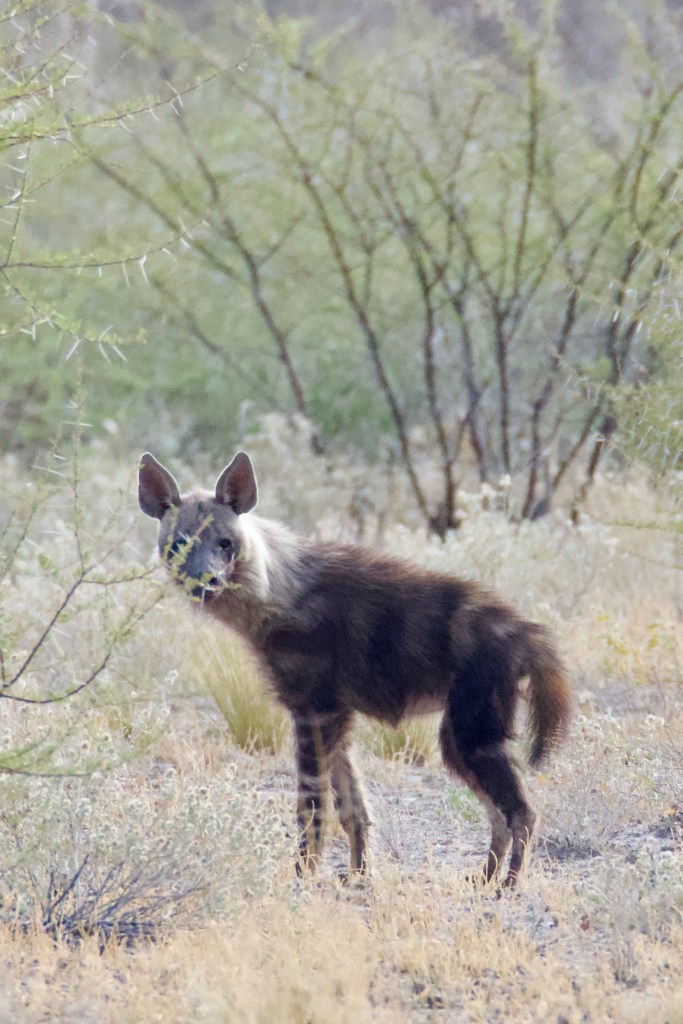
A massive stocky figure had emerged from the bushes beyond the waterhole and was warily looking around. It had clocked us, just as we saw it. Brown Hyena, are mostly solitary, almost fully nocturnal, and rarely observed. We were delighted to spot one. Our visitor was less delighted to see us, but given he was caught out in the open, in the morning sunlight, he now had no choice but to approach the waterhole. He came down to the gap in the bushes in front of us, and took a drink of the fresh water before disappearing into the bushes behind the waterhole from where he came. The whole spectacle was over in five minutes.
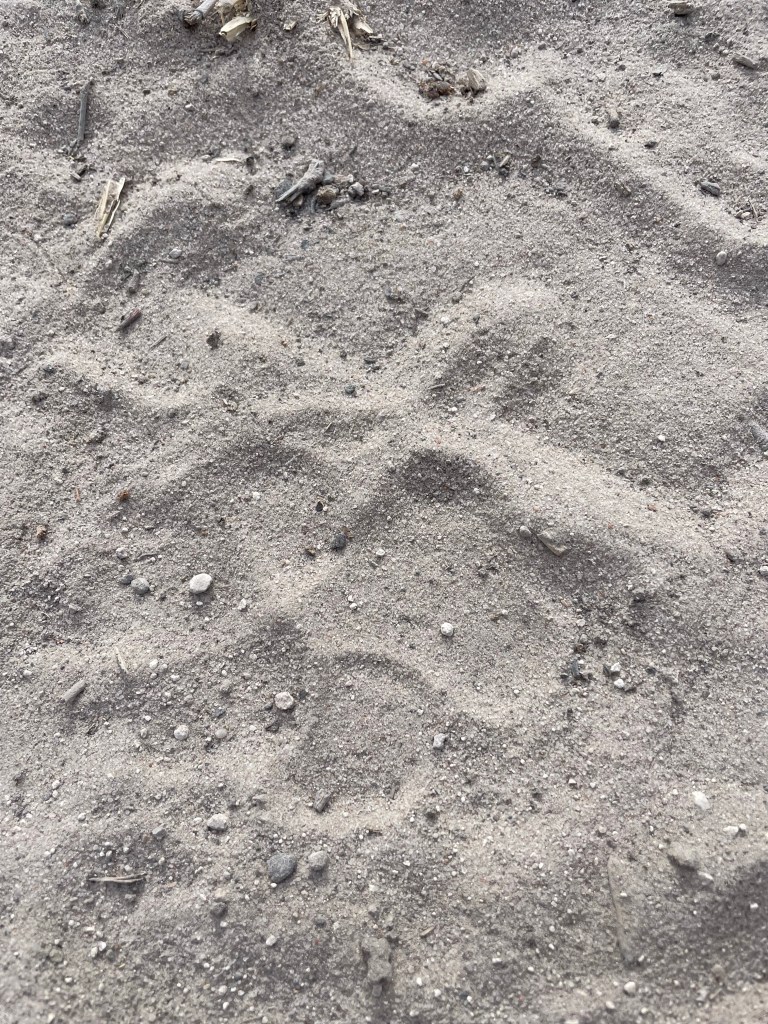
We had watched the hyena whilst sat in the roof of our Land Cruiser. we hopped into the car and drove the 50m or so to the waterhole to check out his tracks.
We were startled, a car had approached us from the the west. Downwind and in the dry Kalahari air, we had barely heard it. You’re not really supposed to leave the vehicle, especially at a waterhole, but we felt safe having seen every coming and going here for the past three hours. The German family who arrived in a bushlore Hilux didn’t care. They had just spotted a cheetah on the pan just five minutes away. We guess the four cheetah tracked by our favourite guide had passed us whilst we obsessed over the hyena.
We tried to track down the elusive cheetah but to no avail, so began the journey back towards deception valley. Where we would stay the night at deception camp once more.
Entering deception camp at around 3pm, we toured the campsites to introduce ourselves to our neighbours. The place was deserted. Just the two guys from Czechia whom we’d bumped into all the way over on Phokoje Pan in the west of the park the day before. We chatted for a while before heading out on an evening drive.
Deception Loop was our destination for the evening, a promising looking area with large and attractive trees dotted around a fairly open grassland. The statistics pinned this as a productive area for game, but the lack of a permanent water source and the well advanced dry season meant our odds of a good sighting weren’t great. Indeed it was the case, we spotted two honey badgers separately busying themselves in the late afternoon sun. A honey badger out in the open in the daytime is something either of us had seen before visiting the CKGR. In fact if you take away any sightings in camps where they’re attempting to steal food, then a honey badger in the daytime is a pretty rare sighting in much of Southern Africa. By this point we’d seen six or so, we let them be.
Back at camp we rejoined with our Czech friends. Their evening drive was similarly unproductive. We shared safari stories until it was too dark to drive back to our camp. So we set up our tent in their camp, braaied together, and had some more beers.
Sarah taught Milan and Dan about constellations, and in return we had a good chuckle about their extensive morning routines.
Distance: 97km
Cumulative Distance: 1,489km





Sunday Pan
Dan and Milan did indeed rise at 5am, make a cup of tea each, followed by a cup of coffee each, and two cigarettes. by way of contrast our alarm is at 5:57 and we aim to leave camp by 6:10.
We tried one last time at Sunday pan, to try to locate the Sunday pride. According to the statistics posted on the notice board at the Matswere gate, by a wide margin Sunday pan is the most productive area in the whole CKGR. Statistically today was to be our day.
It was not. Yet again the Sunday pan pride had stayed elusive. Yet again fresh tracks headed to the waterhole, starting on the main road from deception around 2km south of the pan. Yet again the lions had a drink at the waterhole, and had set off to the southwest. Yet again the prints reached the end of the dead end road and turned south. No sign of the lions. Dan and Milan had followed us to Sunday pan, they were at least interested in what we had to tell them about the lions, and genuinely seemed curious to learn about the tracks. That or they’re good actors. We made a cup of tea and then set off back towards Rakops.
It took us 1:30 to reach Matswere gate from deception camps. A large group of 9 vehicles on a tour arrived from Rakops at the same time we reached the gate. All Brazilians they were staying at Sunday pan. That one group was more people than we’d seen in the entire 6 days we’d been inside the game reserve. We met a nice Dutch couple Corrine and Pascal who were heading to Deception Valley. We wished them good luck with their sightings, in return they gave us some nice chocolates. It took us a further 1:20 to Rakops. The last part of the road back to the town is in terrible condition, and that’s in the context of it being a sand road across the desert to nowhere. The middle track is badly rutted for maybe 10km. The secondary tracks are just as bad. My only tip is to stay as far away from the road as possible where the going is least bumpy.
At Rakops we refuelled, our trip around the CKGR was 626km and had used 88 litres of fuel. At 14.1 L/100km the Land Cruiser is a thirsty animal when running on sand. We had barely engaged 4WD over this time, so I dread to think how much fuel we’d have burned if we’d kept it on. We currently average about 11 L/100km on the tar roads which is marginally more wallet friendly.
Camelthorn Farmstead near Khumaga was our campsite, an hour north of Rakops on a smooth tar road, the drive was pleasant and dull. We were running low on supplies, boerewors and steak had all been consumed in the desert, leaving us with a dinner of beans and tinned tomatoes. Most importantly though, our campsite had an excellent shower. Even a mediocre shower would have sufficed at this stage. We managed one bucket shower in the desert, and even then our solar shower bag had already broken. The surprising lack of mosquitoes at Khumaga was the icing on the cake, we were very comfortable.
Distance: 206km
Cumulative Distance: 1,695km


 Small Holiday Big Dream
Leave a comment