It says so in the constitution therefore it is an immutable fact. Sucre is Bolivia’s capital city.
The seat of government is in La Paz, as are all the functions you’d expect in a capital city, so internationally it’s recognised as such. At nearly 4,000m above sea level it sits proudly on top of the list of all capital cities, at least in a vertical sense.
Santa Cruz is the real industrial centre of Bolivia, it’s twice the size of anywhere else in the country, it should certainly have a claim too. Down on the plains where there are mosquitoes and bugs. We didn’t visit.
I’m probably going to repeat a lot of the above in the travelogue. You’ll have to indulge me.

Sucre
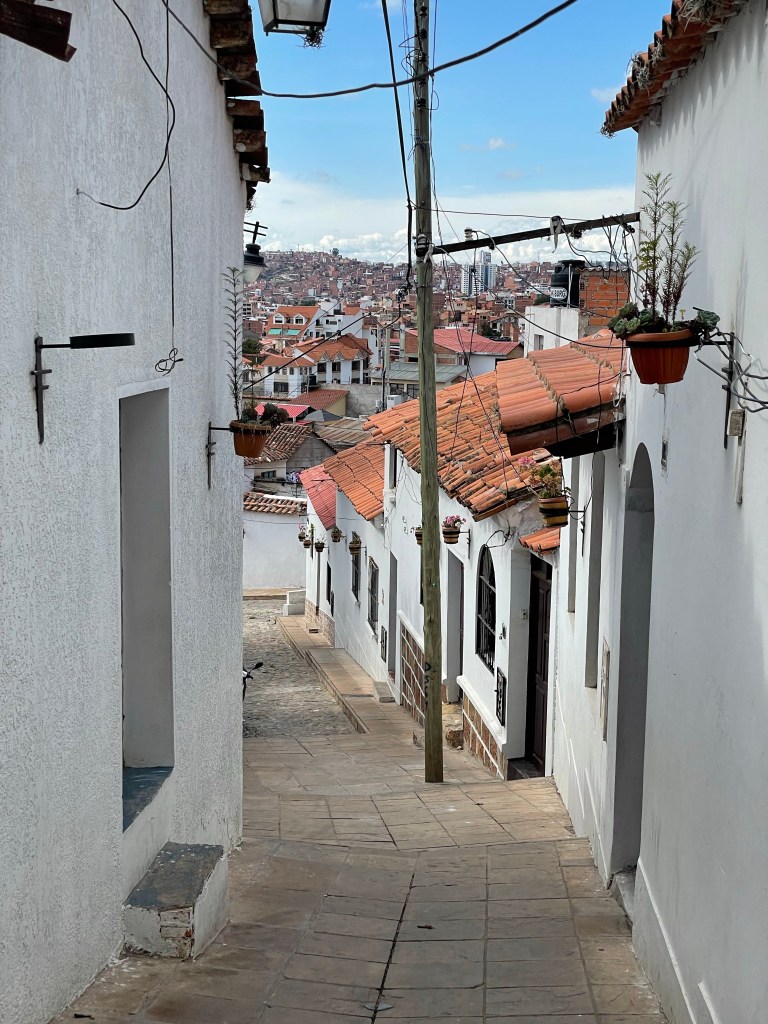
Bolivia’s capital in spirit, if not really in practice, Sucre is a charming little city devoid of the urban sprawl and terrible urban planning of many South American cities.
Easy to access from Potosi via a regular and terrifying four hour bus service, Sucre is closer to the centre of Bolivia. The climate is welcoming, and at a more acceptable altitude of 2,700m, we could breathe easier.
Known as the White City, Sucre is another one on that UNESCO list. All the buildings in and around the centre are whitewashed and have pretty red roofs, accounting for the nickname.
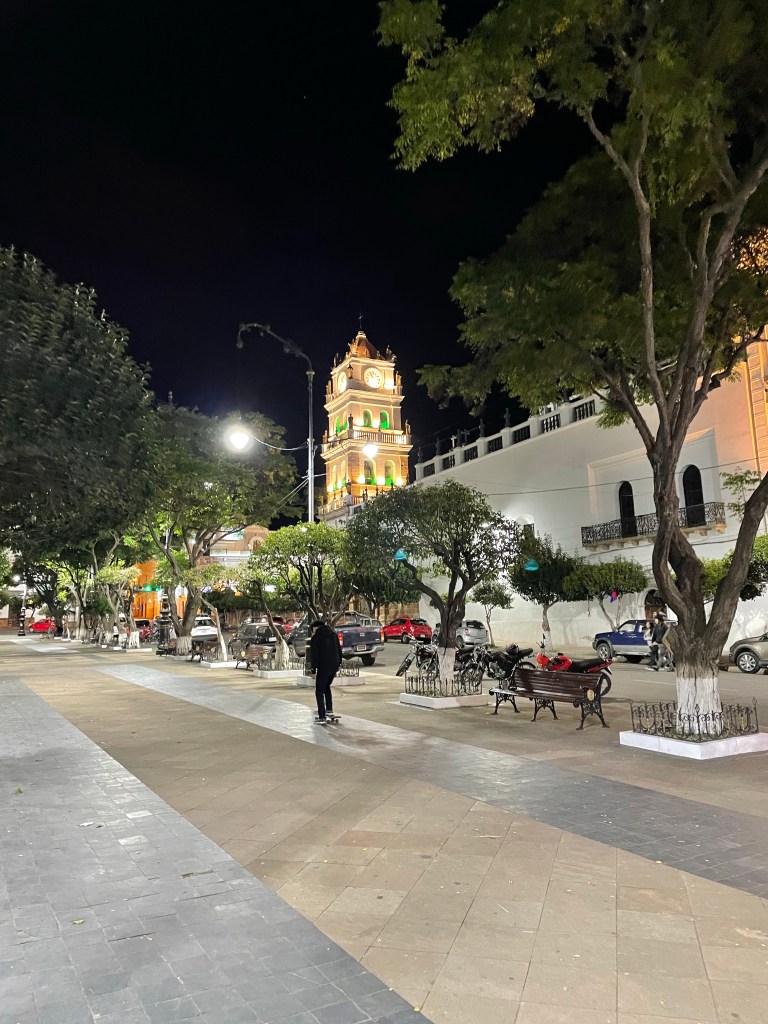
The central square is yet again a delight, lush and well manicured trees ringed by some of the most important buildings in Bolivia. The cathedral and the palace of the constitution are the most impressive.
Truth be told there wasn’t a whole load to do in Sucre. The city is a nice place to be, but there isn’t much past that.
A short walk up the hill to another nice square gives you a nice view of the city and all its white buildings. There is a restaurant which offers a seven course tasting menu for 80 BOB per person (£9), we got most of the way through before one of us was a bit too ill to continue, unrelated to this specific meal it has to be said. It was decent for the price.
We tried Bolivian Saltenas at the must visit spot. Saltenas are a kind of empanada made from a very sweet pastry and a mildly spicy filling. They are very much a national specialty of Bolivia. Originally they were made by the wife of a local Bolivian man, whom everyone quite insultingly forgot the name of. What was important was that she was Argentinian, and from Salta. So Saltenas got their name because everyone used to say – “get the empanadas from the woman from salta” – how nice.
The story does tie in nicely with other parts of my blog though – namely that the best empanadas are from Salta.



Cal Orck’o
At 11am from the corner of the main square in Sucre you can catch the “dino bus”
For only 15 BOB (£1.5) per person return, it’s a bargain. It’ll take you right up to the entrance of the enormous cement factory on the outskirts of town.
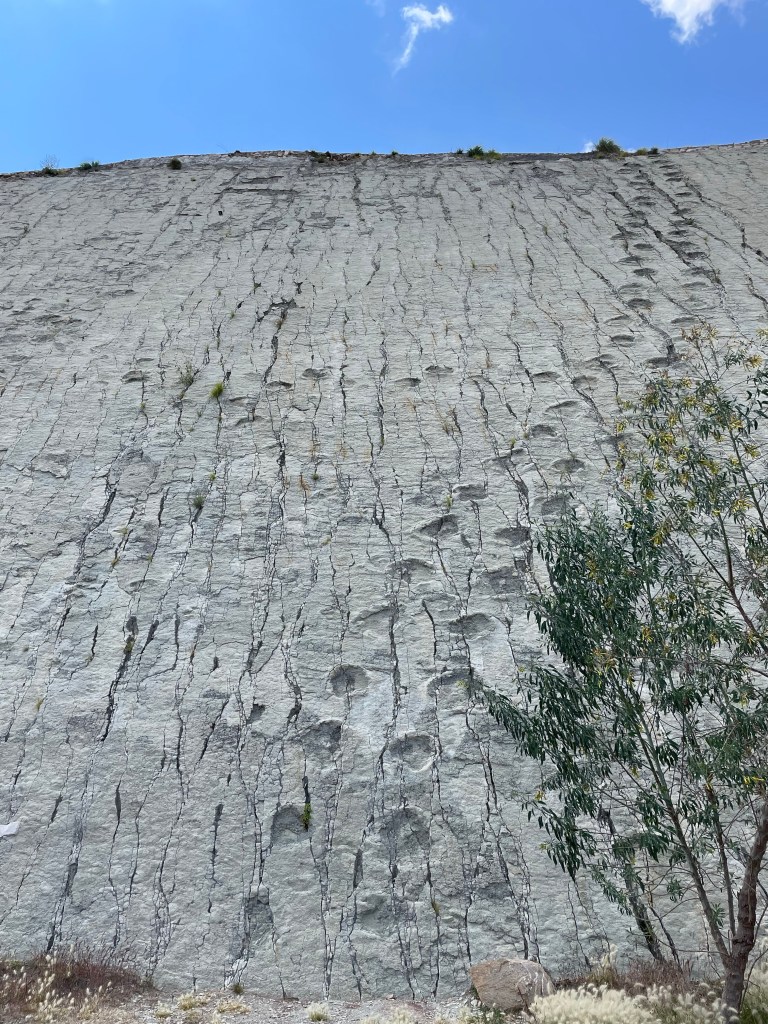
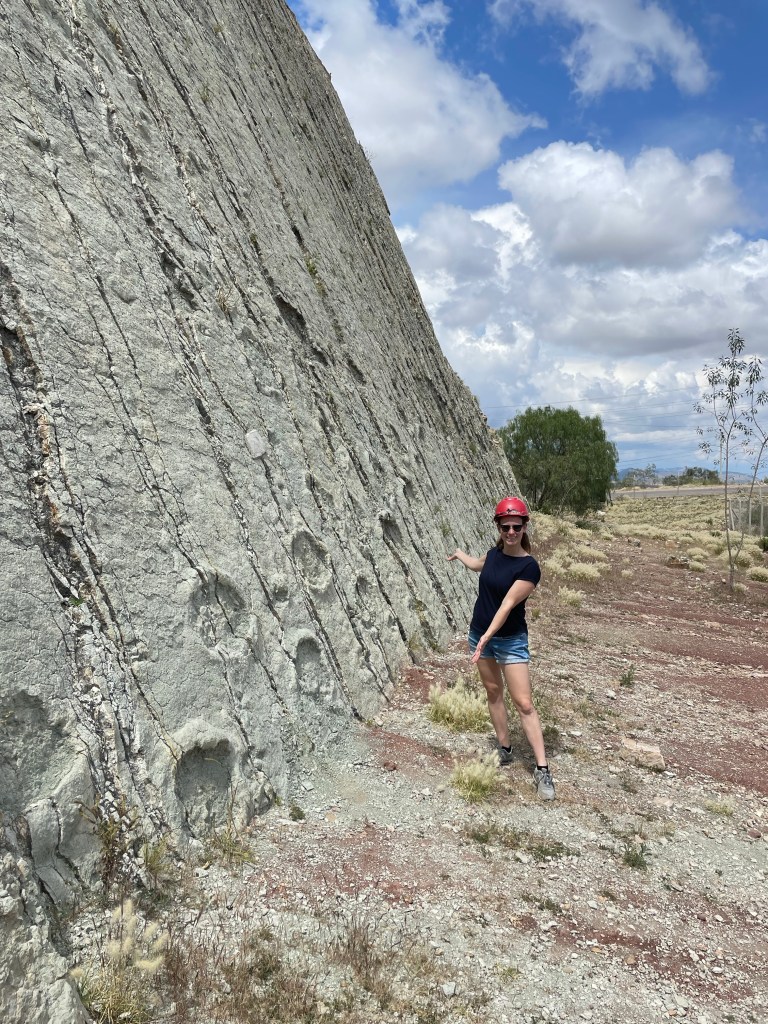
Said cement factory made an extraordinary discovery in the 1990s. An enormous limestone wall covered in over 12,000 dinosaur footprints.
Known as the Cal Orck’o, this is perhaps the best place in the world to see dinosaur footprints. There are tracks of Sauropods, extremely well preserved and very obviously dinosaur tracks. There’s a pair of parallel titanosaur tracks, and an inordinate number of terrasaur tracks. Also – I have to mention for Theo’s sake – there are many Ankylosaurus tracks.
A small museum at the site gives some more details. I should report we made it back to Sucre safely.
Our evening accommodation was the sleeper bus to La Paz. Which was 12 hours away, but actually a very comfortable journey thanks to the roomy full cama bus. Finally a decent bus service courtesy of Trans Copacabana.
Teaser: try to spell the dinosaur footprint place again. It’s almost impossible to remember…



La Paz
I’m not allowed to call La Paz the capital of Bolivia, even though it’s clearly the capital of Bolivia.
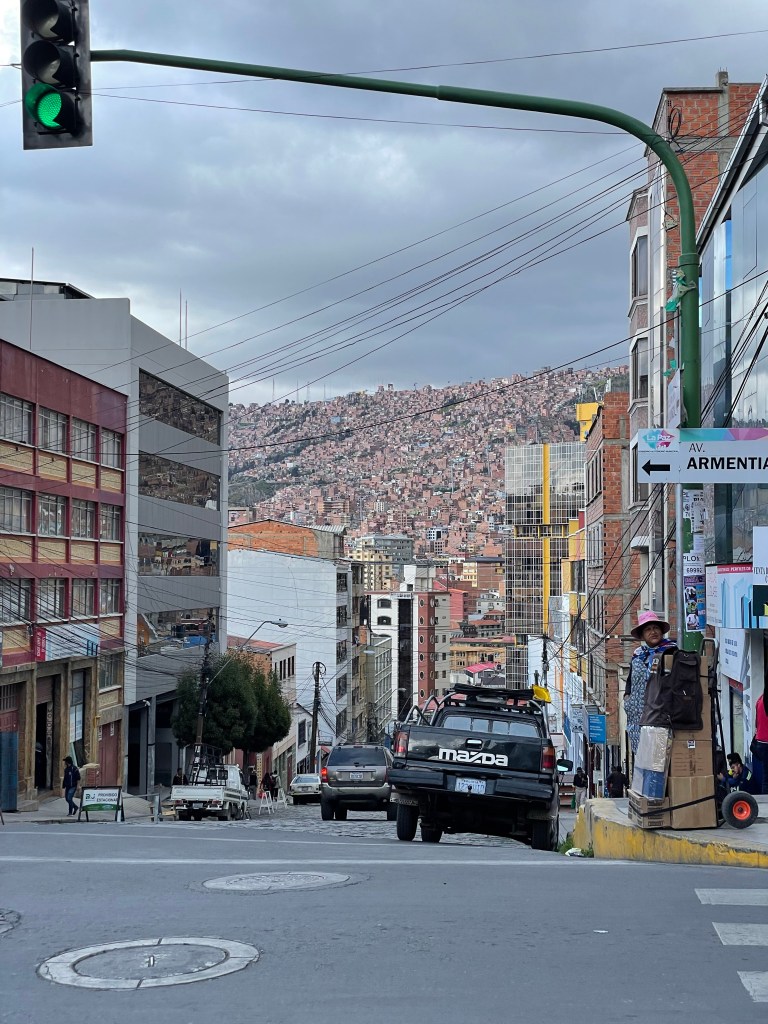
Nestled in a steep valley at almost 4,000m above sea level, it’s a spectacular city, especially when you enter from above.
We dropped off our bags at our hotel, and made a beeline for the first free walking tour we could find. Although strangely this was a free walking tour we had to pay in advance for. A brief but strange tax/government/mafia/hand wavy explanation was given and we said no more about it.
First up we learnt about the notorious San Pedro prison. Inside its walls there is a completely autonomous criminal community. There are no police or prison officers on the inside, only round the perimeter. Interestingly many residents aren’t criminals, but the wives and children of inmates, allowed outside to go to work or school twice a day.
It sounds as if the economy of the prison is driven almost entirely by the export of cocaine, and the process by which the goods are exported can often be viewed from San Pedro square where we were currently stood. Although it simply sounds like launching a package off the roof. You’d be wise to not touch the package though, it’s for someone more dangerous than you.
At one point in the past it was possible to go inside on prison tours. This practice has now stopped, and it’s probably for the best.
At the witches market you can buy an array of potions and superstitious items. Most prominently on sale are desiccated llama foetuses. These are used as an offering to pachamama during the construction of buildings. The bigger the house the bigger the llama needed. For large buildings there’s the myth of needing a human sacrifice, although this is just urban legend.
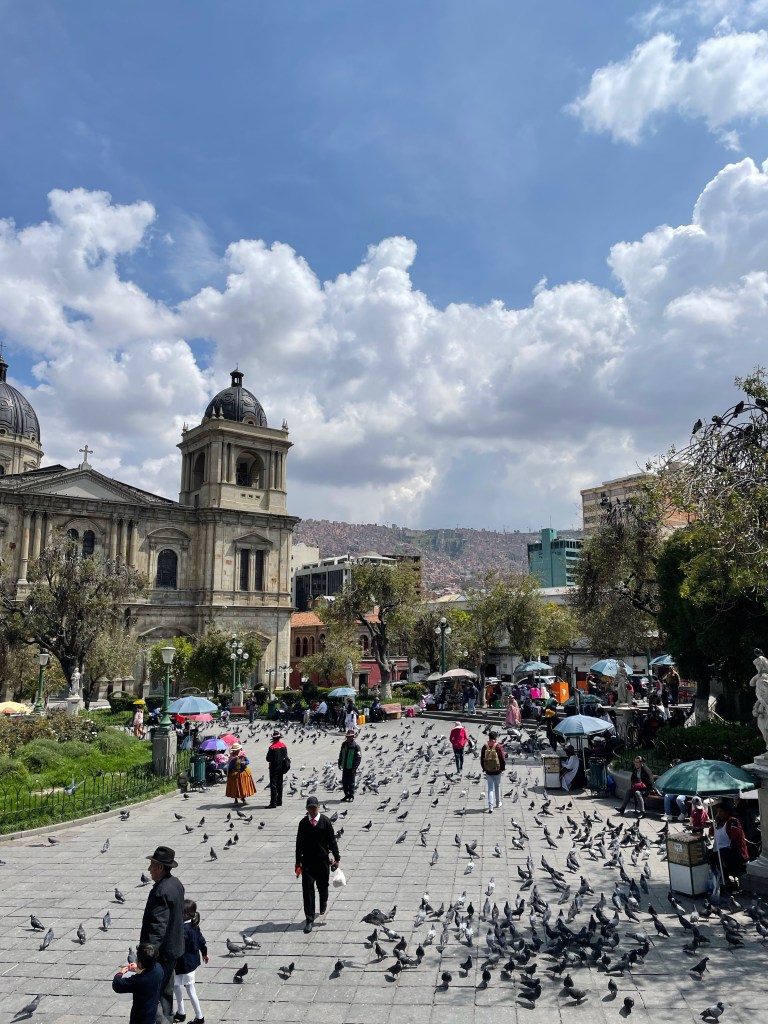
San Francisco church has an eclectic mix of catholic and native iconography adorning its exterior walls. Originally sited in the native side of town, a clear goal of the construction was the conversion of the locals. Even today results appear mixed.
On the Spanish side of town lie all the major governmental buildings, including Evo Morales monstrous palace of the people.
The square is also home to the famous backwards clock, installed in 2014 as the clock of the South. The claim was that being in the southern hemisphere necessitated a clock that went the other way from the northern hemisphere’s. Although that left an open goal and perhaps the easiest political rebuttal in history when the opposition pointed out the clock going backwards mirrored Bolivia’s progression under the ruling party.
Our afternoon was spent riding around on La Paz’s magnificent cable car system. For 3 BOB or 30p a go you can travel all around the city, they’re clean and smooth, but I reckon the capacity isn’t all that. Still, the grey line that runs along the crest of the valley edge up in El Alto gives a spectacular view across the whole of the city.





Gustu
Gustu is probably one of the fanciest restaurants in Bolivia. For £40 each you can have an eight course tasting menu. The crocodile ceviche was pretty good, as was the watermelon thing. It’s easy to get to on the cable car too. If you’re in La Paz it’s a good thing to do.


- The infamous Binga-Karoi road
- Mana Pools: A bucket list location?
- Camping Among Lions: Chitake Springs Experience
- Chirundu: The worst border in the world
- The Wild Dogs of Jeki: Sunrise in Lower Zambezi
 Small Holiday Big Dream
Leave a comment